What a skincare manufacturer actually does, and why buyers should care
When people search for a skincare manufacturer, they are usually not looking for marketing language. They want a supplier that can turn an idea into a sellable product without introducing avoidable risk. That may sound simple until you get into packaging compatibility, filling behavior, formula stability, and the practical question of whether the product can survive real-world handling. A spray bottle, for example, can look straightforward on the shelf, but the bottle body, closure, actuator, and formulation all need to work together if you want a product that feels reliable in the hand and consistent in use.
This matters to sourcing teams because the wrong manufacturing partner can create problems long before a product reaches market: leakage, poor spray performance, inconsistent fills, packaging delays, or a formula that behaves differently from batch to batch. For product teams, the decision is even broader. You are not just choosing a vendor. You are choosing who will shape the final customer experience.
That is why it helps to think about skincare production as a system. A good supplier is rarely just “a cosmetic factory” in the loose sense. It is a combination of formulation capability, filling process control, packaging know-how, and the discipline to keep details from slipping. Those details are where many projects succeed or fail.
Why the package format can matter as much as the formula
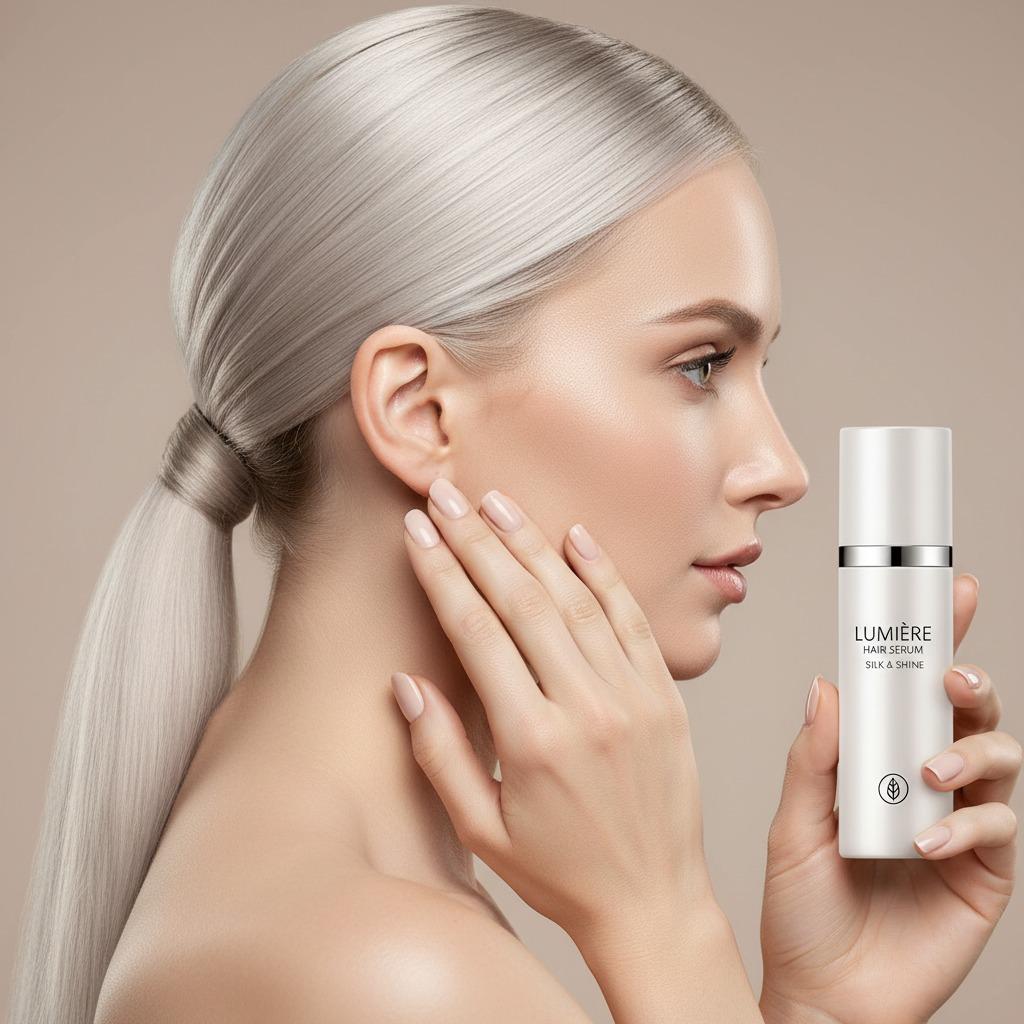
The product information here points to a handheld spray bottle cosmetic or personal-care item, likely for hair or scalp use. That kind of format is common in grooming, refresh, and treatment products because it gives the user a controlled application. Instead of pouring, scooping, or rubbing in a cream, the consumer can target a specific area with a mist or spray. For hair and scalp care, that convenience is not a small feature; it often determines whether the product gets used regularly.
The visible bottle details are practical enough to be worth noticing. The container appears to be a white plastic bottle with a matte or satin finish and a dark spray nozzle or cap. The label design is minimal. None of that tells us the exact formula, and it should not be read that way, but it does suggest a product built around simple handling and direct application. Buyers often underestimate how much the package shape affects perceived quality. A clean, stable spray format can make a modest formulation feel more professional, while a poorly chosen closure can undermine an otherwise good product.
In beauty and personal care, the package is not just a shell. It is part of the product specification.
Quick reference: what buyers should evaluate first
Before choosing a skin care factory or cosmetic factory, it is worth separating the conversation into four parts:
Formula: Does the manufacturer understand the product type, intended use, and target skin or hair application?
Package: Can they source or coordinate the bottle, spray assembly, label, and secondary packaging so the product performs as intended?
Process control: Do they have enough discipline in filling, assembly, and inspection to reduce avoidable variation?
Commercial fit: Can they support the order size, export market, and timeline your channel actually requires?
Those are basic questions, but they filter out many weak suppliers quickly. A buyer does not need every answer on day one, but they do need to know whether the supplier can discuss these topics in a concrete way rather than relying on vague reassurance.
How manufacturing usually breaks down in skincare and personal care
Even when the finished item is small, the production path tends to follow a familiar sequence. A skincare manufacturer typically works through product definition, material selection, formulation or sourcing, packaging procurement, filling, assembly, labeling, and final inspection. Each step has its own failure modes.
1. Product definition
This is where the buyer and supplier decide what the item is supposed to do. In this case, the image suggests a spray format for hair or scalp care, but the exact product type is not verifiable from the provided information. That uncertainty matters. A leave-in mist, a refreshing spray, and a scalp treatment may all use a similar bottle shape, but they can require different dispensing behavior and different compatibility testing.
2. Packaging selection
The bottle material, closure style, and label all need to support the product. A white plastic bottle is common because it is lightweight and portable. The spray nozzle suggests direct application and controlled output. But buyers should still ask whether the closure is suited to the formulation’s viscosity and whether the spray pattern is stable over time. A cosmetic factory that handles packaging well will usually discuss these issues without prompting.
3. Filling and assembly
At this stage, small process errors become expensive. Spray products are especially sensitive to inconsistent filling volumes, contamination, and poor cap fit. A clean-looking bottle means little if the sprayer clogs or leaks in transit. This is where factory discipline matters more than brand language.
4. Final inspection and packing
Even a straightforward personal-care product should be inspected for cosmetic defects, closure security, and labeling accuracy. For export buyers, outer packing and shipping protection deserve attention too. The best-looking bottle on a showroom shelf is not much help if it arrives scuffed or partially discharged.
What the available company information suggests, and what it does not
The company information provided for SAIL describes a business focused on heavy-duty transport solutions, including semi-trailers, trucks, and related auto parts such as axles and filters. It also mentions a modern facility, an annual capacity of over 30,000 units, OEM/ODM services, and export experience in the Middle East, Africa, and Southeast Asia. Those details are useful, but they do not indicate skincare manufacturing capability. In fact, they point to a different industrial specialization altogether.
That distinction is important because buyers sometimes search broadly for “manufacturer” and assume any factory with export capabilities can produce adjacent consumer goods. Usually, that is not a safe assumption. A transport equipment manufacturer and a personal-care manufacturer operate with very different materials, compliance requirements, and production disciplines. If you are sourcing a spray bottle cosmetic item, you would want a supplier with actual cosmetic or personal-care production experience, not just general manufacturing capacity.
So the practical takeaway is simple: factory scale alone is not a substitute for category fit.
Common buyer mistakes when sourcing from a cosmetic factory
One common mistake is focusing too early on packaging appearance. A minimal black-and-white label and a clean white bottle can look premium, but appearance does not tell you whether the dispenser works, whether the contents are stable, or whether the supplier can repeat the same result in bulk.
Another mistake is treating all spray products as interchangeable. In reality, nozzle choice, bottle geometry, and formula texture all interact. A product that sprays fine in a short demo may perform differently after storage, shipping vibration, or repeated use. Buyers should ask for samples that are close to the final setup, not just a loose concept bottle.
A third issue is underestimating use environment. Hair and scalp products are often handled in bathrooms, salons, and travel kits. That means condensation, temperature swings, and repeated opening and closing are normal conditions. A skin care factory that understands real usage will account for this during packaging selection and testing discussions.
Practical selection criteria for sourcing managers
If you are evaluating a skincare manufacturer, keep the discussion grounded in operational questions:
Can they explain their package sourcing and compatibility checks?
Do they understand the difference between a cosmetic bottle, a treatment spray, and a general-purpose dispenser?
Can they support OEM/ODM work if your market needs a custom format?
Are they able to discuss quality checks in plain terms, without hiding behind broad claims?
Can they show you how they handle labeling, batch consistency, and packaging protection for export?
Those questions are not glamorous, but they are the ones that protect margin and reputation.
How to read a sample product like the one described here
The visible spray bottle tells us a few things worth noting. It is portable. It is designed for controlled application. It uses a plastic body, which is a common choice for consumer convenience. The dark spray top gives the item a practical, utilitarian look rather than a decorative one. That may suit a grooming or treatment product where user trust matters more than flashy design.
At the same time, the product image does not tell us the formula, the bottle capacity, the intended user group, or whether the product is for cosmetic only, salon use, or something more specialized. Buyers should resist the temptation to infer more than the image supports. In sourcing, false certainty causes expensive mistakes.
Buyer-facing FAQ
Is a skin care factory always the same as a cosmetic factory?
Not necessarily. The terms overlap in casual conversation, but in practice a manufacturer may specialize in specific product categories, packaging systems, or filling methods. Category fit matters more than the label.
Does a spray bottle product need special attention?
Yes. Spray products depend on the interaction between bottle, nozzle, formulation, and assembly quality. Even a small mismatch can affect user experience.
Should I choose a supplier based on factory size alone?
No. Capacity is useful, but only when it matches the product category and quality expectations. Large output does not guarantee relevant experience.
What should I ask for first?
Ask for product category experience, packaging options, sample configuration, and the supplier’s process for checking compatibility and consistency. Those answers are more useful than broad promises.
What a good next step looks like
If you are building a personal-care spray product, the next step is not to chase the lowest quote. It is to identify a manufacturer that can prove category competence, packaging discipline, and repeatable output. For a buyer, that usually means asking for a sample package close to the intended final format, then checking how it behaves in handling and use. For a product team, it means deciding early whether the bottle, nozzle, and label are part of the product design or an afterthought.
That distinction will save time later. A dependable skincare manufacturer helps you make those decisions early, before the project gets locked into avoidable compromises. And when the product is something as visible and tactile as a spray bottle cosmetic, those early decisions tend to show up on the shelf whether you planned for them or not.