American Mahjong: what buyers and players actually need to know
American Mahjong is easy to underestimate until you sit down with the tiles, the card, and four people who all think they are reading the same hand differently. For buyers, club organizers, and casual players, the challenge is not just finding a set that looks good on the table. It is understanding how American Mahjong rules shape the equipment, how the table surface affects play, and what features help keep a game orderly rather than constantly interrupted by sliding tiles and lost pieces.
That matters because the game is as much about organization as it is about chance. A set of tiles, a stable playing surface, and a clear layout can make the difference between a smooth evening and a table full of confusion. If you are sourcing American Mahjong sets for home use, social groups, or recreational venues, the decision is less about decoration than about usability, durability, and how well the product supports the rhythm of the game.
Quick reference: what a practical American Mahjong setup includes
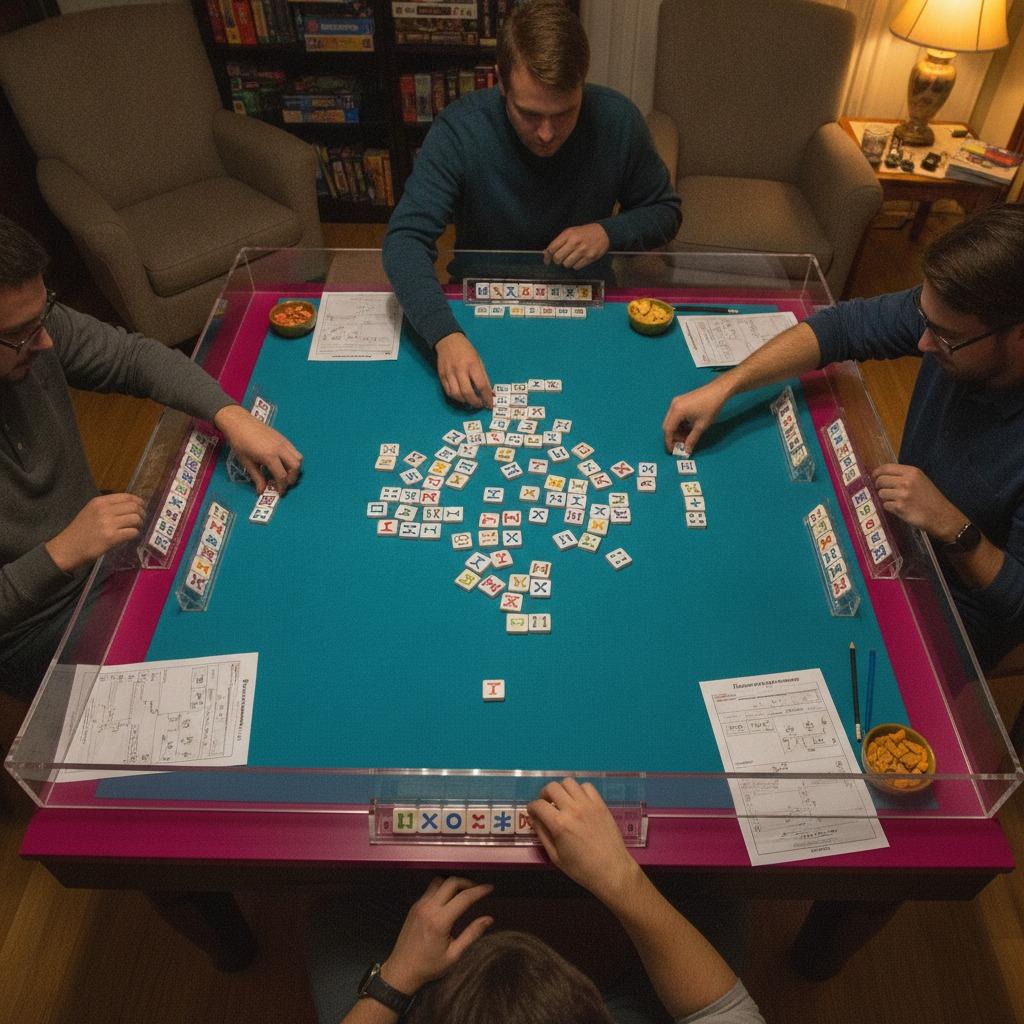
A typical American Mahjong setup centers on a square playing area, loose tiles, and printed reference materials. In the product information provided here, the visible setup includes a square tabletop surface with raised transparent side rails or framing, a green felt-like playing area, border graphics in pink and blue, and small square tiles with printed markings. Rule or score sheets are also visible around the edges.
That combination tells you something useful: the product is designed to contain movement. Tiles can be shuffled, sorted, and dealt within the enclosed perimeter without constantly sliding off the edge. For recreational play, that is not a minor detail. It reduces interruptions, protects the tiles, and helps players focus on the game rather than on chasing pieces under the table.
How American Mahjong differs from other tile games
People often use the term mahjong loosely, but American Mahjong has its own structure and reference system. The game is normally played with a specific hand card, and that changes what players need at the table. A set that works well for one regional style may feel awkward in another if the tile markings, number of tiles, or reference aids do not match the expected format.
For that reason, American Mahjong rules should always be checked against the actual set contents. A buyer should not assume that any square tile set is automatically suitable. The markings, the way the tiles are sorted, and the presence of score or instruction materials all affect how quickly new players can join in. In practice, the most useful sets are the ones that support fast identification and reduce table clutter.
Why the playing surface matters more than it looks
Mahjong tables are often discussed as if they are just furniture, but the surface is part of the game system. A smooth green playfield helps tiles slide predictably during shuffling and dealing, while raised rails keep the action inside the boundary. Clear side walls are especially useful in home and club settings where the table is shared, the room is busy, or players are not all equally experienced.
There is also a practical caution here: a good-looking surface that is too slippery or too soft can be a nuisance. Tiles should move enough to be handled comfortably, but not so much that every bump sends them out of place. That balance is one reason enclosed or framed tabletop products have become popular for casual American Mahjong play.
American Mahjong sets: what to look for before you buy
If you are evaluating American Mahjong sets, start with the basics. Are the tiles easy to read at a glance? Does the set include enough visual structure for players to sort quickly? Is the table or mat large enough for four players to manage their tiles without crowding the center? These questions sound obvious, but they are where many purchases go wrong.
From the provided product description, the tiles appear to be rigid square pieces, likely plastic or melamine, with colored character or symbol markings. That is a sensible choice for recreational use because hard tiles tend to hold up better than softer alternatives and are easier to clean after repeated handling. The visible border graphics and enclosed edge design also suggest a product intended for repeated social play rather than one-time decorative use.
Material and construction clues buyers can trust
The product information points to a mixed construction: molded transparent plastic or acrylic rails, a textile- or vinyl-like green playing surface, and separately produced tiles. That is a common approach in assembled gaming products. It allows the manufacturer to combine a stable frame with a playable surface that feels familiar to experienced players.
For sourcing managers, this kind of construction has a straightforward implication: quality depends on both parts working together. A sturdy frame is not enough if the mat wrinkles, and a good play surface will not save a table with loose edge pieces. When reviewing sample units, check the joints, the fit between the rails and the base, and whether the tiles sit comfortably inside the playfield without catching on the perimeter.
Common buyer mistakes that cause avoidable frustration
The first mistake is buying for appearance alone. Mahjong has a visual culture, and that is part of its appeal, but a decorative set that is hard to read or awkward to use quickly loses favor. The second mistake is ignoring the table format. A product can be perfectly attractive and still be poor for regular gameplay if the enclosed play area is too small for comfortable sorting.
A third mistake is assuming all groups play the same way. American Mahjong rules can vary by household, club, or region in terms of reference card use, organization habits, and table etiquette. If you are buying for a community group, the safest path is to ask what players already expect to see on the table. A product that simplifies familiar routines will get used; one that forces everyone to adapt may sit in storage.
How to judge whether a design supports real gameplay
In a practical sense, the best mahjong table accessory is the one that keeps the session moving. Look for an enclosed play area that controls loose pieces, a surface that allows easy shuffling, and enough room for players to arrange hands without stacking everything in the center. If printed instruction sheets are included, that is a useful extra for newer groups, though it should not be treated as a substitute for a clear understanding of the game.
For home buyers, ease of setup matters too. A product that is easy to store or bring out for game night can get more use than a heavier, more elaborate option. For clubs, the priority often shifts toward durability and repeatability. In both cases, the same basic truth holds: if the table helps people keep the game orderly, it earns its place.
Practical advice for sourcing and product selection
When reviewing American Mahjong sets for retail or group purchasing, ask for clear product images that show the tile markings, edge construction, and surface finish. If dimensions, tile count, or folding details are not supplied, do not guess. Those are exactly the details that affect buying decisions, and they should be confirmed before placing volume orders.
It is also worth separating the role of the table from the role of the tiles. Some buyers want a permanent gaming surface; others want a portable accessory that can be brought out for occasional play. The product described here appears to lean toward a tabletop format with an enclosed playfield, which makes sense for social and recreational use. That kind of setup can be a strong choice when the goal is to keep the game contained and easy to reset between rounds.
FAQ
Are American Mahjong rules the same everywhere?
No. The game is played with a shared general structure, but local habits and reference-card use can vary. Buyers should confirm the expectations of the target group before choosing a set.
Do I need a special table to play?
Not always, but a dedicated or accessory table helps. A square surface with raised edges is especially useful because it keeps tiles from scattering and supports organized dealing.
What makes one set better than another?
Readability, durability, and table control usually matter more than novelty design. A good set supports fast sorting and stable play, which is what most players value once the game starts.
What a buyer should do next
If you are selecting American Mahjong equipment for a household, club, or retail program, focus on the way the product performs at the table rather than the way it looks in a catalog image. Verify the tile markings, check the enclosed play area, and confirm that the construction suits the intended use. For frequent social play, a contained tabletop format with a smooth surface and secure rails is a practical choice that reduces fuss and protects the tiles over time.
If you need help matching a product format to your market, your next step should be to compare the actual play experience, not just the product description. The details that matter most are usually the simplest ones: how the tiles move, how the table contains them, and whether the set makes American Mahjong easier to play or merely more attractive to display.