Teddy Bear Plush Toy Wholesale: The Complete B2B Sourcing & Buyer Guide
The wholesale plush toy industry generates billions in annual revenue, yet sourcing the right teddy bear at the right price—with consistent quality across thousands of units—remains one of the trickiest procurement challenges in the soft goods sector. Whether you're filling shelves for a children's retail chain, planning a branded promotional campaign, or building a private-label gift line, the gap between a successful teddy bear plush toy wholesale order and a costly mistake often comes down to supplier evaluation, production transparency, and packaging logistics.
This guide is written for commercial buyers, procurement managers, and brand owners who need a clear, practical framework for placing bulk teddy bear orders—from initial design brief through final container loading. We'll cover supplier qualification, OEM workflow, quality benchmarks, cost levers, and the decision points that separate reliable partners from risky ones.

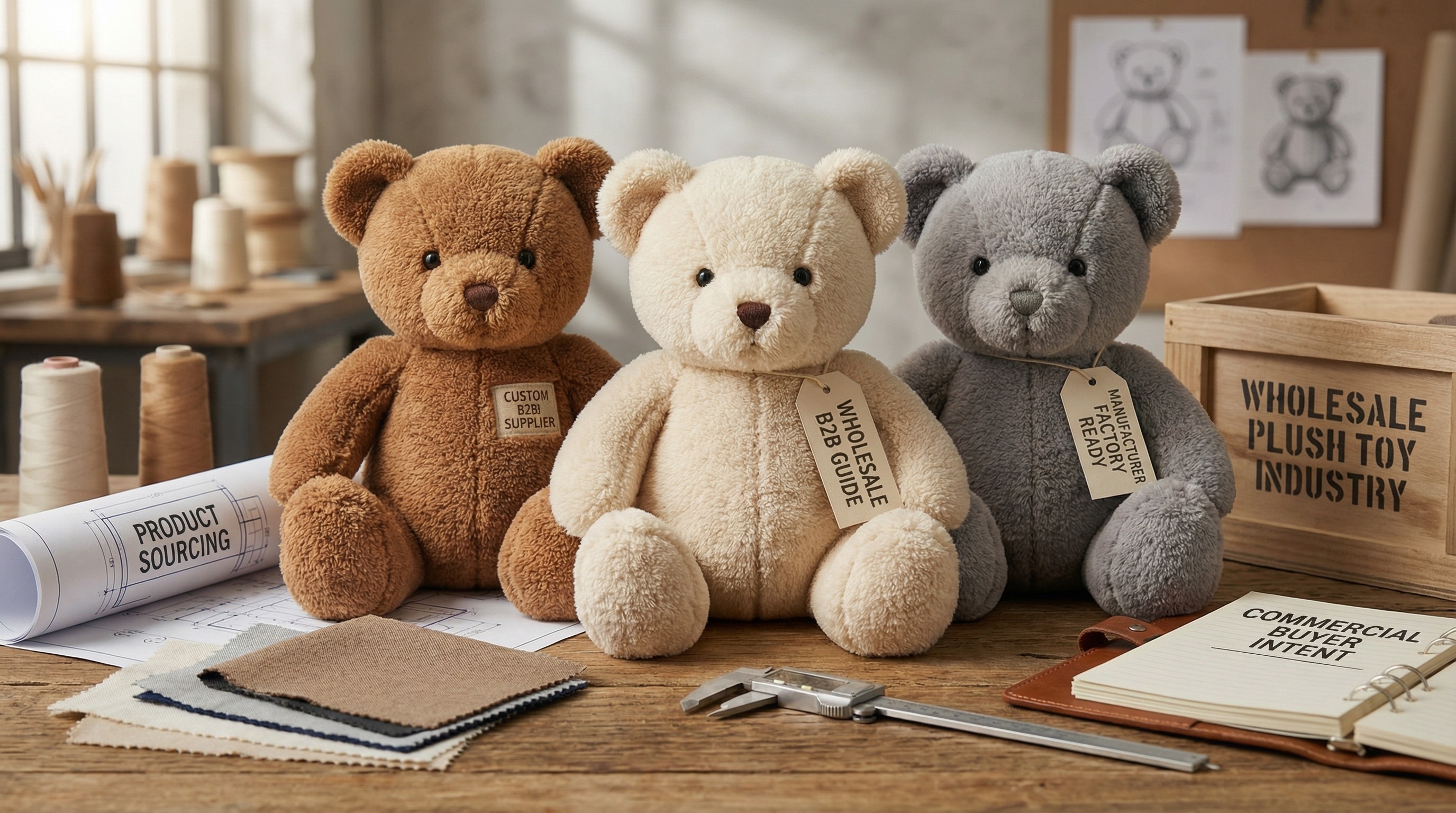
Plush teddy bears staged for wholesale evaluation—fabric hand-feel, fill density, and embroidery detail are the first quality signals buyers should assess.
Quick Answer: What Does Teddy Bear Plush Toy Wholesale Actually Involve?
At its core, a wholesale plush toy transaction means purchasing teddy bears in commercial quantities—typically 500 to 50,000+ units per SKU—directly from a manufacturer or authorized distributor. The process usually includes:
- Product sourcing — identifying a factory or OEM plush toy supplier with the right materials, certifications, and capacity.
- Sample development — approving a pre-production sample that locks in size, fabric, fill, color, and branding.
- Bulk production — manufacturing at scale with in-line quality inspections.
- Packaging & logistics — inner polybags, master cartons, palletization, and FOB/CIF shipping terms.
The entire cycle—from design brief to port-ready shipment—runs 35 to 75 days depending on order complexity, customization depth, and factory backlog. Understanding each phase lets you compress timelines, control costs, and avoid the quality surprises that plague first-time importers.
B2B Buyer Checklist: Evaluating a Custom Teddy Bear Manufacturer
Not every factory that appears on a sourcing platform can deliver consistent plush toys at scale. Use this checklist before committing to a supplier:
1. Manufacturing Capabilities & Capacity
- Does the factory own cutting, sewing, stuffing, and finishing lines in-house—or does it subcontract critical steps?
- What is the monthly production capacity in units? A credible custom teddy bear manufacturer should be transparent about machine counts, headcount, and peak-season constraints.
- Can they handle multiple SKUs (sizes, colors, branding variants) within a single production run?
2. Compliance & Safety Certifications
- EN 71 (EU toy safety), ASTM F963 (US toy safety), and ISO 8124 are the baseline standards for plush toys entering major markets. Ask for current test reports—not just claims.
- For children under 3, confirm small-parts testing, pull-strength on eyes/noses, and flammability compliance.
- OEKO-TEX or GOTS certifications add value for eco-conscious retail channels.
3. OEM & Customization Depth
- Can the supplier execute custom embroidery, woven labels, hang tags, and Pantone-matched fabrics?
- Do they support private-label packaging with your brand's retail-ready artwork?
- Is there a dedicated project manager for custom plush toy OEM orders?
4. Quality Control Infrastructure
- Request details on in-line inspection at 30% and 70% production completion—this is industry best practice for catching seam-strength failures, fill-weight drift, and color-batch inconsistencies before final packing.
- Pre-shipment inspection (AQL 2.5 for major defects) should be standard, not optional.
5. References & Track Record
- Ask for 2–3 verifiable buyer references in your target market. A strong OEM plush toy supplier will share case studies or at minimum confirm past order volumes by region.
A well-organized production floor is a strong signal of manufacturing capabilities—look for dedicated QC stations, clean material storage, and traceable batch labeling.
Cost & Value: What Drives the Unit Price in Bulk Teddy Bear Orders?
Pricing in the wholesale plush toy industry is never a single number. Here are the main levers:
| Cost Factor | Impact on Unit Price | Buyer Lever |
|---|---|---|
| Order quantity | High — price tiers drop significantly at 1,000 / 3,000 / 10,000 units | Consolidate SKUs or combine orders with partners |
| Fabric type | Medium — crystal super-soft > short plush > cotton blends | Match fabric to price-point expectations; don't over-spec for promo items |
| Fill material | Low–Medium — PP cotton is standard; memory foam or organic fill adds cost | Specify fill weight per unit to prevent inconsistency |
| Customization depth | Medium — embroidery, custom molds for eyes/noses, Pantone matching | Use supplier's existing eye/nose inventory to avoid tooling fees |
| Packaging | Low–Medium — polybag + master carton is cheapest; window boxes or gift tins add $0.30–$1.50/unit | Choose packaging tier based on retail channel requirements |
| Shipping terms | Variable — FOB vs. CIF vs. DDP changes landed cost dramatically | Get quotes on multiple Incoterms; compare total landed cost, not just unit price |
Rule of thumb: A standard 20 cm plush teddy bear in short-pile polyester with PP cotton fill, embroidered eyes, polybag + master carton, typically lands between $1.80 and $4.50 FOB depending on quantity and customization. Premium fabrics, licensed designs, or retail-ready gift packaging can push that above $6.00.
The OEM Production Workflow: From Brief to Bulk Shipment
If you're working with a custom teddy bear manufacturer on a private-label or branded product, the production cycle follows a predictable path. Here's what to expect—and where to intervene:
Stage 1 — Design Brief & Quotation (Days 1–5)
Submit your target size, color references (Pantone codes preferred), fabric preference, fill type, logo placement, and packaging requirements. A professional supplier returns a detailed quotation within 2–5 business days, including unit price tiers by quantity, tooling or setup fees, and estimated lead time.
Stage 2 — Sample Development (Days 6–20)
Expect 7–15 days for a pre-production sample. Review fabric hand-feel, color accuracy, stitching quality, embroidery sharpness, and overall proportion. Approve in writing before production begins—this sample becomes your quality benchmark for the entire run.
Stage 3 — Bulk Production & In-Line Inspection (Days 21–55)
During production, request in-line quality checks at 30% and 70% completion. Key checkpoints include seam strength (pull test), fill weight consistency (±5% tolerance is standard per ISO 8124 guidelines), and color batch uniformity. This is where most quality failures are caught—or missed.
Stage 4 — Final QC, Packing & Shipping (Days 56–70)
Pre-shipment inspection against your approved sample, AQL sampling, and final packing. Confirm master carton dimensions and gross weight against your freight booking. Plush toys are volumetric—container utilization matters more than weight for shipping cost.
Master carton labeling, inner polybag sealing, and palletization readiness—the final mile of a successful bulk teddy bear order.
Common Application Scenarios for Wholesale Teddy Bears
- Retail & e-commerce inventory — gift shops, toy stores, department stores, and Amazon/Shopify sellers buying seasonal or evergreen SKUs.
- Promotional & corporate gifting — branded teddy bears for trade shows, loyalty programs, hospital donations, or employee appreciation kits.
- Amusement & carnival prizes — high-volume, lower-cost bears sized for claw machines and game booths.
- Charity & nonprofit — comfort bears for children's hospitals, disaster relief, or fundraising campaigns.
- Private-label brand building — emerging DTC brands launching their own plush line with custom design, packaging, and story.
Each scenario demands a different balance of cost, customization, and compliance. A carnival prize bear at 15 cm doesn't need OEKO-TEX certification or a gift box—but a hospital comfort bear for children under 3 absolutely needs EN 71 and ASTM F963 compliance. Define your end-use case before you finalize specs.
Frequently Asked Questions
What is the typical MOQ for teddy bear plush toy wholesale?
Most factories set MOQs between 300 and 1,000 units per design. Custom OEM orders with new patterns or tooling tend toward the higher end. Stock designs from existing molds may allow lower minimums.
How do I verify a supplier's safety certifications?
Request the actual lab test report (not just a certificate image) and confirm the testing lab is ISO 17025 accredited. Cross-reference the report number with the lab's online verification portal when available.
Can I mix sizes and colors within one bulk teddy bear order?
Yes, but each variant typically needs to meet a per-SKU minimum (often 100–300 pieces). Mixing too many variants in a small total order raises unit cost because of setup changes on the production line.
What shipping method is best for plush toys?
Sea freight is standard for large orders because plush toys are high-volume, low-weight. Vacuum-packing can reduce carton volume by 40–60%, significantly improving container utilization. Air freight is viable only for urgent small orders or samples.
How do I protect my custom design from being copied?
Sign an NDA and a clear OEM agreement that specifies design ownership. Register your design in key markets before production. Work with suppliers who have a track record of respecting IP—ask for references.
Related Solutions Worth Exploring
If you're expanding your product sourcing beyond plush toys, our catalog includes a range of wholesale-ready products across categories. Browse our full product catalog for complementary inventory ideas, or visit our resource blog for more illustrated sourcing guides—including our in-depth companion piece on teddy bear plush toy wholesale B2B sourcing strategies.
Conclusion: Build a Stronger Supply Chain for Plush Toy Wholesale
Successful teddy bear plush toy wholesale sourcing isn't about finding the cheapest unit price—it