Why Teddy Bear Plush Toy Wholesale Still Drives Serious Margin in 2025
Plush toys remain one of the most resilient categories in the global toy and gift market. Within that category, teddy bears account for a disproportionate share of wholesale volume—driven by seasonal gifting, promotional campaigns, theme-park merchandise, and private-label retail programs. Yet for procurement teams sourcing at scale, the gap between a profitable container and a warehouse full of rejected stock often comes down to supplier selection, material specification, and production oversight.
This guide is built for teddy bear plush toy wholesale buyers who need to evaluate manufacturers, compare cost structures, and lock down quality before committing to large orders. Whether you're a retailer building a house brand, a promotional distributor fulfilling a corporate campaign, or an amusement operator refreshing prize inventory, the framework below will sharpen your sourcing process.

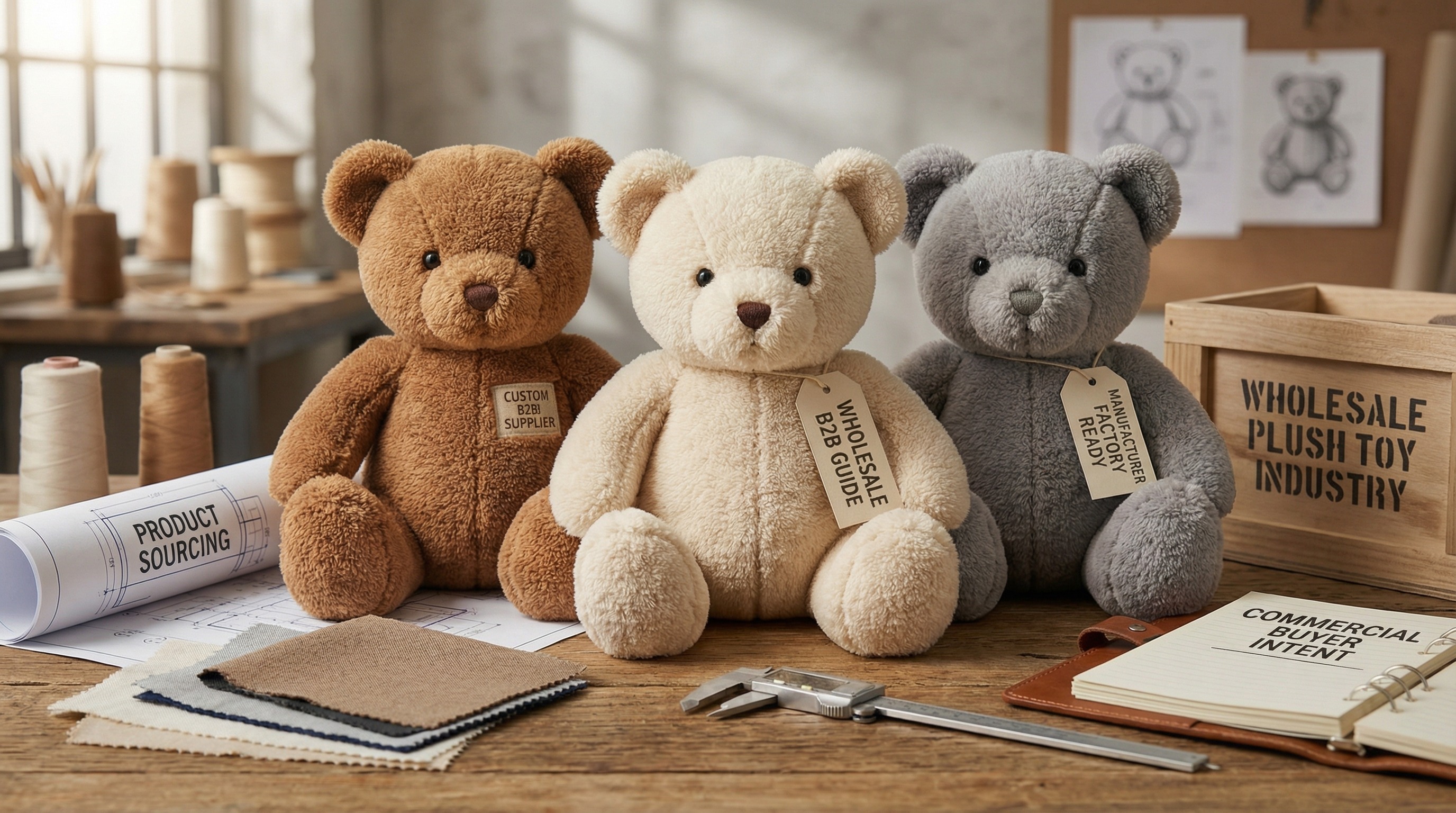
Wholesale teddy bear plush toys staged for bulk shipment — material, fill, and stitching quality vary dramatically between suppliers.
Quick Answer: What Does Teddy Bear Plush Toy Wholesale Actually Cost?
Landed cost per unit for a standard 20–30 cm teddy bear ranges from $1.20 to $4.80 FOB, depending on material grade, fill type, embroidery complexity, and order volume. Custom designs with embroidered logos, hang tags, and retail-ready packaging typically add 15–30% to the base price. MOQs from established factories generally start at 500–3,000 pieces per SKU, though some OEM plush toy suppliers offer lower thresholds for repeat buyers.
The real cost variable isn't unit price—it's rejection rate. A supplier quoting $0.40 less per bear but delivering inconsistent fill weight or off-shade fabric will cost you far more in chargebacks, re-inspection, and lost retail shelf space.
Buyer Checklist: 8 Verification Points Before You Order
Use this checklist during supplier evaluation. Each point addresses a common failure mode in plush toy wholesale procurement.
- Safety certifications: Confirm EN 71 (EU), ASTM F963 (US), or GB 6675 (China domestic) compliance. Request current test reports from an accredited lab—not self-declarations. The ASTM F963-23 standard, updated in 2023, tightened requirements on small parts and flammability.
- Material traceability: Ask for fabric mill certificates. Crystal super-soft plush, short-pile velboa, and minky fabrics each have different hand-feel, durability, and cost profiles.
- Fill specification: PP cotton (polyester fiberfill) is standard. Confirm denier, staple length, and whether recycled or virgin fiber is used. Recycled fill can meet quality standards but must be verified for contaminants.
- Stitching and seam strength: Request pull-test data. A reliable custom teddy bear manufacturer will test seams to at least 70 N (newtons) for products marketed to children under 36 months.
- Color matching: Require Pantone references and pre-production color swatches. Dye-lot variation across production runs is the most common aesthetic complaint in wholesale plush.
- Embroidery and print capability: Evaluate stitch count, thread quality, and registration accuracy for logos and facial features.
- Packaging options: Polybag with suffocation warning, individual box, display carton, or bulk pack. Packaging choice affects both landed cost and retail readiness.
- Production lead time: Standard is 30–45 days after sample approval. Peak-season orders (ahead of Valentine's Day, Christmas) should be placed 90+ days out.
Production-floor detail: embroidery stations and QC checkpoints are where custom teddy bear quality is won or lost.
Custom Teddy Bear Manufacturer vs. Stock Supplier: Decision Matrix
Not every buyer needs full OEM customization. The table below helps you decide which sourcing model fits your program.
| Factor | Stock / Catalog Supplier | Custom Teddy Bear Manufacturer (OEM) |
|---|---|---|
| MOQ | 100–500 pcs | 500–3,000 pcs per design |
| Lead time | 7–15 days (in-stock) | 30–60 days (sample + production) |
| Unit cost | Higher per unit | Lower at volume; tooling/sample fees apply |
| Branding | Hang-tag or ribbon add-on only | Full custom: fabric, shape, embroidery, packaging |
| Exclusivity | None — same SKU sold to competitors | Design ownership possible with NDA |
| Best for | Small retailers, gift shops, quick-turn promos | Private-label brands, licensed merchandise, large promos |
If your program requires branded packaging, unique colorways, or IP-licensed designs, working with a dedicated OEM plush toy supplier is the only viable path. Stock suppliers serve well for fill-in orders and market testing, but they offer zero differentiation at retail.
How to Evaluate an OEM Plush Toy Supplier
Factory audits—whether in-person or via third-party inspection firms like SGS or Bureau Veritas—remain the gold standard. But before you invest in an audit, screen suppliers with these practical steps:
1. Sample Quality Review
Order 2–3 samples of existing products and request a custom sample based on your spec sheet. Compare the two. A factory that produces clean catalog samples but struggles with custom work is signaling a capacity or engineering gap.
2. Communication Responsiveness
Plush production involves iterative feedback on patterns, materials, and colorways. If a supplier takes 72+ hours to respond during the quoting phase, expect worse during production. Prioritize manufacturers with dedicated English-speaking project managers.
3. Reference Clients
Ask for 2–3 reference buyers in your market segment. A credible custom teddy bear manufacturer will share references willingly. If they refuse, treat it as a red flag.
4. In-Line Inspection Access
Confirm that the factory permits third-party inspection at three stages: pre-production (material check), during production (30% completion), and pre-shipment (final random inspection per AQL 2.5). Factories that resist inspection access are not worth the risk at wholesale volume.
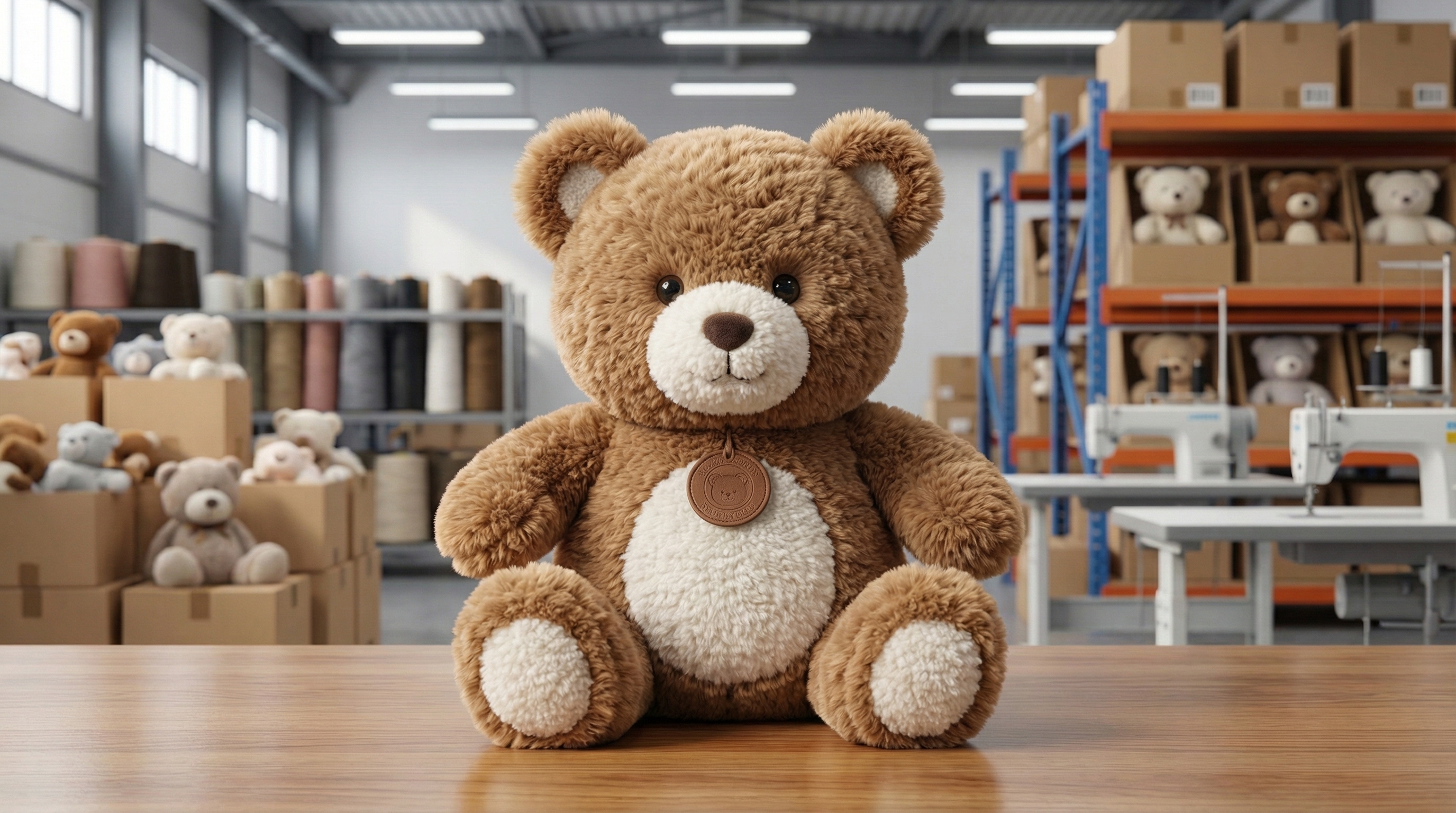
Finished wholesale teddy bears packed for export — carton markings, poly-bag specs, and pallet configuration all affect your landed cost.
Packaging, Shipping, and Delivery Readiness
Plush toys are lightweight but volumetric. Shipping costs are almost always calculated by cubic meter (CBM) rather than weight, which means packaging efficiency directly impacts your freight bill.
- Vacuum compression: Some suppliers offer vacuum-packed bears that reduce CBM by 40–60%. Confirm that the plush recovers its shape after decompression—low-quality fill may not.
- Carton configuration: Standard export cartons (60×40×40 cm) should be palletized to maximize container utilization. A 40 ft HC container typically holds 65–70 CBM.
- Retail-ready packaging: If bears ship directly to store shelves, confirm UPC/EAN barcode placement, shelf-ready display trays, and suffocation-warning compliance for poly bags (per ASTM D3951).
- Incoterms: Most wholesale plush is quoted FOB or CIF. For first-time suppliers, consider CIF to simplify logistics until the relationship is proven.
Application Fields: Where Wholesale Teddy Bears Sell
Understanding end-use helps you brief your OEM plush toy supplier more effectively:
- Retail private label: Supermarkets, department stores, and online marketplaces. Requires retail packaging, safety compliance, and consistent reorder capability.
- Promotional merchandise: Corporate gifts, event giveaways, hospital comfort programs. Typically branded with logos; lower fill quality acceptable for short-life-cycle items.
- Amusement and carnival prizes: Theme parks, claw machines, fairgrounds. High volume, moderate quality, bright colors, and oversized options (60–120 cm).
- Specialty and collector markets: Limited-edition bears, artist collaborations, memorial bears. Premium materials, hand-finished details, numbered certificates.
Frequently Asked Questions
What is the typical MOQ for teddy bear plush toy wholesale?
For stock designs, MOQs can be as low as 100–500 pieces. Custom OEM orders usually require 500–3,000 pieces per SKU, depending on factory size and design complexity.
How do I verify safety compliance for plush toys?
Request third-party lab test reports for the applicable standard (EN 71 for Europe, ASTM F963 for the US). Reports should be issued by accredited labs such as SGS, Intertek, or TÜV and dated within the last 12 months.
Can I get my own brand on wholesale teddy bears?
Yes. A capable custom teddy bear manufacturer will offer private labeling including woven labels, embroidered logos, custom hang tags, and branded packaging. Provide vector artwork files and Pantone color references for best results.
How long does OEM plush toy production take?
Expect 7–14 days for sample development and approval, followed by 25–45 days for mass production. Rush orders may be possible at a 10–20% premium.
What's the difference between PP cotton and PE pellet fill?
PP cotton (polyester fiberfill) provides a soft, huggable feel and is standard for most teddy bears. PE pellets add weight and a beanbag-like feel, often used in the base or paws for stability. Many designs combine both.
Related Resources on Our Site
If you're deepening your sourcing research, these resources may help:
- Teddy Bear Plush Toy Wholesale: The Complete B2B Sourcing Guide — an expanded deep-dive into factory evaluation and negotiation.
- Teddy Bear Plush Toy Wholesale: B2B Sourcing Guide — additional comparison data for buyers evaluating multiple suppliers.
- Browse our full product catalog to see current wholesale-ready inventory and custom-capable product lines.
Next Step: Start Your Wholesale Inquiry
Sourcing teddy bear plush toy wholesale at scale requires more than a price quote—it demands material verification, production transparency, and a supplier who treats your brand standards as their own. Whether you need 1,000 stock bears for a seasonal promotion or 50,000 custom-designed units for a private-label launch, the right manufacturing partner makes the difference between margin and markdown.
Ready to move forward? Submit your sourcing inquiry here with your target specs, volume, and timeline. Our team will respond with a detailed quotation, sample options, and production schedule within 48 hours.