Teddy Bear Plush Toy Wholesale: The Illustrated B2B Sourcing & Buying Guide
Few product categories in the wholesale plush toy industry combine emotional appeal, year-round demand, and high customization potential quite like the teddy bear. Whether you're a retail chain buyer filling seasonal shelf space, a promotional agency sourcing 10,000 branded giveaways, or a gift-box curator assembling corporate kits, teddy bear plush toy wholesale sourcing decisions directly affect your margin, lead time, and brand reputation.
Yet the category is routinely misunderstood. Buyers over-index on unit price and under-invest in sample validation, safety compliance, and packaging planning—mistakes that surface as chargebacks, customs holds, or disappointed end customers. This guide gives you a structured, procurement-grade framework for evaluating suppliers, managing OEM production, and placing a confident bulk teddy bear order.

A well-sourced teddy bear line begins with clear specs, verified samples, and a supplier whose manufacturing capabilities match your volume and compliance requirements.
Quick Answer: What Does Teddy Bear Plush Toy Wholesale Actually Involve?
At its core, wholesale plush toy procurement means securing a reliable pipeline of soft-stuffed products—at scale—while controlling for safety certification, visual consistency, fill quality, and delivery timing. A typical B2B transaction covers:
- MOQ negotiation — Most factories set minimums between 500 and 3,000 units per SKU, depending on customization depth.
- Material and safety specification — Fabric type (crystal plush, minky, organic cotton), fill material (PP cotton, recycled polyester), and compliance standard (EN 71, ASTM F963, CPSIA).
- OEM/ODM scope — Logo embroidery, custom colorways, hang-tag design, and bespoke packaging.
- QC protocol — In-line inspections, pre-shipment AQL sampling, and third-party testing.
- Logistics planning — Carton configuration, palletization, FOB/CIF terms, and container utilization.
If any of those line items feel unfamiliar, the checklist below will ground your next sourcing cycle.
B2B Buyer Checklist: 8 Non-Negotiables Before You Place a Bulk Teddy Bear Order
Use this checklist as a pre-qualification filter when you're evaluating any OEM plush toy supplier or custom teddy bear manufacturer. Each item addresses a common failure point in the supply chain.
- Verified factory audit or third-party certification — Request a BSCI, Sedex, or ISO 9001 certificate. If the supplier can't produce one, ask for a recent factory-audit report from a recognized inspection firm.
- Safety-test library — A credible manufacturer should hold current EN 71 (EU) and/or ASTM F963 (US) test reports for their standard product lines. For children's products sold in the US, CPSIA Section 101 lead and phthalate testing is mandatory.
- Pre-production sample with written approval — Never skip this. The sample is your quality benchmark for the entire run. Evaluate fabric hand-feel, color accuracy, stitching quality, embroidery sharpness, and proportion fidelity.
- Transparent pricing tiers — Unit cost should decrease at clear volume breakpoints (e.g., 500 / 1,000 / 5,000 / 10,000 pcs). Watch for hidden tooling, die-cut, or setup fees.
- In-line QC access — Request inspection windows at 30% and 70% production completion. Key checkpoints: seam strength, fill weight consistency, and color-batch uniformity.
- Packaging and inner-carton specs — Confirm individual polybag thickness, suffocation-warning labels, carton dimensions, and master-carton gross weight for freight planning.
- Lead-time commitment with penalty clause — Standard bulk production runs 25–45 days after sample approval. Get the timeline in writing.
- Communication responsiveness — A professional supplier returns a detailed quotation within 2–5 business days. If initial response time exceeds a week, expect worse delays during production.

Evaluating fill density, seam integrity, and embroidery detail during the sample-approval stage prevents costly rework at scale.
Cost vs. Value: What Drives Pricing in the Wholesale Plush Toy Industry?
Unit price is the most visible number on a quotation—and the least useful in isolation. Here's what actually shapes your landed cost and long-term value:
| Cost Driver | Low-Cost Scenario | Premium Scenario | Impact on Buyer |
|---|---|---|---|
| Fabric | Standard crystal plush | OEKO-TEX® certified minky or organic cotton | Hand-feel, safety claims, retail positioning |
| Fill Material | Virgin PP cotton | GRS-certified recycled polyester | Sustainability story, compliance with EU green-claim rules |
| Customization Depth | Stock design, label swap only | Full OEM: custom pattern, Pantone match, bespoke packaging | Brand differentiation, higher MOQ, longer lead time |
| Order Volume | 500–1,000 pcs | 5,000–50,000 pcs | Unit-price reduction of 15–35% at higher tiers |
| Testing & Compliance | Supplier's existing test reports | Buyer-commissioned third-party lab testing per lot | Liability protection, retailer-gate compliance |
| Packaging | Polybag + brown export carton | Retail-ready window box, printed insert, branded tissue | Shelf appeal, unboxing experience, added cost $0.30–$1.20/unit |
Key takeaway: A $0.40 per-unit fabric upgrade can shift your product from a forgettable impulse buy to a gift-grade item that supports a 2–3× retail markup. Always evaluate cost in the context of your channel and end-customer expectations.
OEM Production Workflow: From Design Brief to Delivery
If you're working with a custom teddy bear manufacturer on an OEM or ODM project, the production pipeline follows a well-defined sequence. Understanding it lets you plan marketing calendars, warehouse intake, and cash-flow timing with confidence.
Stage 1 — Design Brief & Quotation (Days 1–5)
Submit your target size, color palette (Pantone references preferred), fabric preference, fill type, logo placement, and packaging requirements. A professional OEM plush toy supplier returns a detailed quotation within 2–5 business days, including unit price tiers by quantity, tooling or setup fees, and estimated lead time.
Stage 2 — Sample Development (Days 6–20)
Expect 7–15 days for a pre-production sample. Approve in writing—this document becomes your contractual quality benchmark. If revisions are needed, budget an additional 5–7 days per round.
Stage 3 — Bulk Production & In-Line Inspection (Days 21–55)
During production, request in-line quality checks at the 30% and 70% milestones. Critical checkpoints include seam strength (pull-test), fill weight consistency (±5% tolerance is standard), and color-batch uniformity. Reference ISO 2859-1 (sampling procedures for inspection by attributes) to set your AQL levels—Level II, AQL 2.5 for major defects is a common B2B benchmark.
Stage 4 — Final Inspection, Packing & Shipping (Days 56–65)
Pre-shipment inspection covers workmanship, labeling accuracy, barcode scannability, and carton drop-test. Confirm container loading plans early—plush toys are volume-sensitive, and poor carton configuration can waste 10–15% of container space.
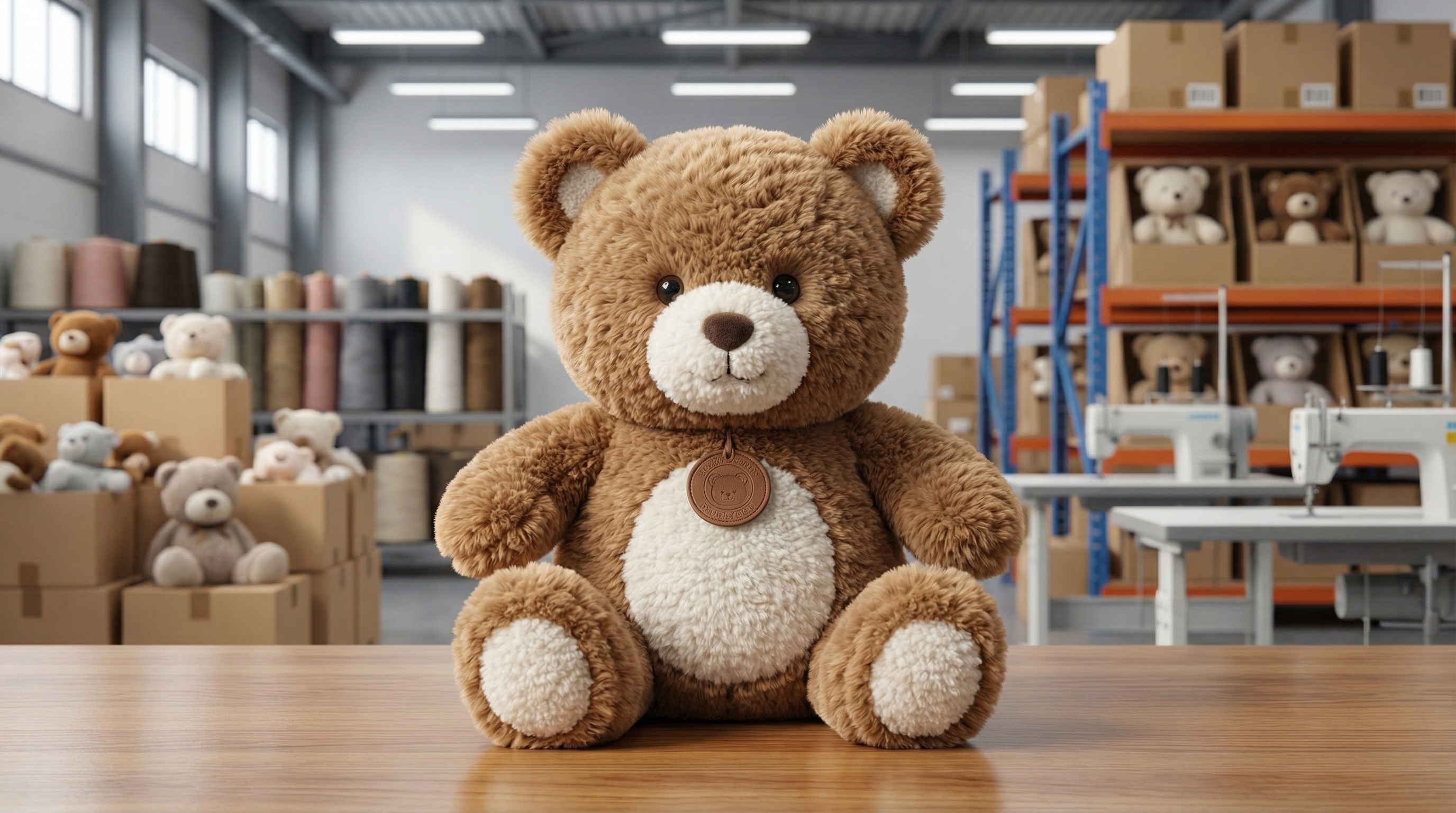
Finished goods packed for export—carton markings, polybag suffocation warnings, and palletization specs should all be confirmed before production begins.
Application Scenarios: Who Buys Teddy Bears in Bulk?
Product sourcing for plush teddy bears spans a surprisingly wide range of commercial buyer profiles:
- Retail chains & e-commerce brands — Seasonal stock (Valentine's, Christmas, graduation) and evergreen nursery/gift lines.
- Promotional agencies — Branded bears for insurance companies, hospitals, real-estate closings, and automotive dealership giveaways.
- Hospitality & tourism — Hotel gift shops, zoo and museum retail, theme-park merchandise.
- Corporate gifting — Employee welcome kits, client appreciation boxes, charity-event auction items.
- Subscription-box curators — Monthly kids' boxes, pet-toy subscriptions (with modified safety specs).
Each scenario implies different commercial buyer intent: the retail buyer prioritizes shelf-ready packaging and barcode compliance; the promo buyer needs fast turnaround and logo accuracy; the corporate buyer values premium unboxing and small-batch flexibility. Clarify your use case before you brief a supplier.
Supplier Evaluation: Red Flags and Green Lights
Green Lights
- Factory provides a virtual or on-site tour with production-floor visibility.
- Existing test reports reference recognized labs (SGS, Bureau Veritas, Intertek, TÜV).
- Clear documentation of manufacturing capabilities: cutting, sewing, stuffing, embroidery, and heat-transfer printing lines.
- Willingness to sign an NDA and IP-protection agreement for custom designs.
Red Flags
- No factory address or audit history available.
- Quotes that are 40%+ below market without a clear material or volume explanation.
- Refusal to provide a pre-production sample or insistence on full payment before sampling.
- Vague lead-time language ("about one month, maybe") with no milestone schedule.
Frequently Asked Questions
What is the typical MOQ for a bulk teddy bear order?
For stock designs with label customization only, MOQs often start at 500 pieces. Fully custom OEM designs—new patterns, Pantone-matched fabrics, bespoke packaging—typically require 1,000–3,000 pieces per SKU to justify tooling and setup costs.
How long does OEM plush toy production take?
Plan for 45–65 days from sample approval to goods-ready date, depending on order complexity and factory loading. Add 2–5 weeks for ocean freight or 5–7 days for air freight to your destination port.
Which safety standards apply to teddy bears?
For the US market, ASTM F963 and CPSIA (lead, phthalates, tracking labels) are mandatory for children's products. For the EU, EN 71 Parts 1–3 cover mechanical/physical,
Explore our products, browse more blog guides.