Teddy Bear Plush Toy Wholesale: The Complete B2B Sourcing & Procurement Guide
Whether you're a retail chain buyer stocking shelves for the holiday season, a promotional goods distributor fulfilling a branded campaign, or an amusement park operator sourcing thousands of prize-tier plush toys, teddy bear plush toy wholesale sourcing is one of those deceptively complex procurement tasks. The product looks simple—until you start navigating MOQs, safety certifications, fill-weight tolerances, and the gap between a factory sample and a 10,000-unit production run.
This guide breaks down the entire sourcing process: how to evaluate a custom teddy bear manufacturer, what to look for in an OEM plush toy supplier, the cost variables that actually move your landed price, and the quality checkpoints that separate a reliable partner from an expensive lesson.

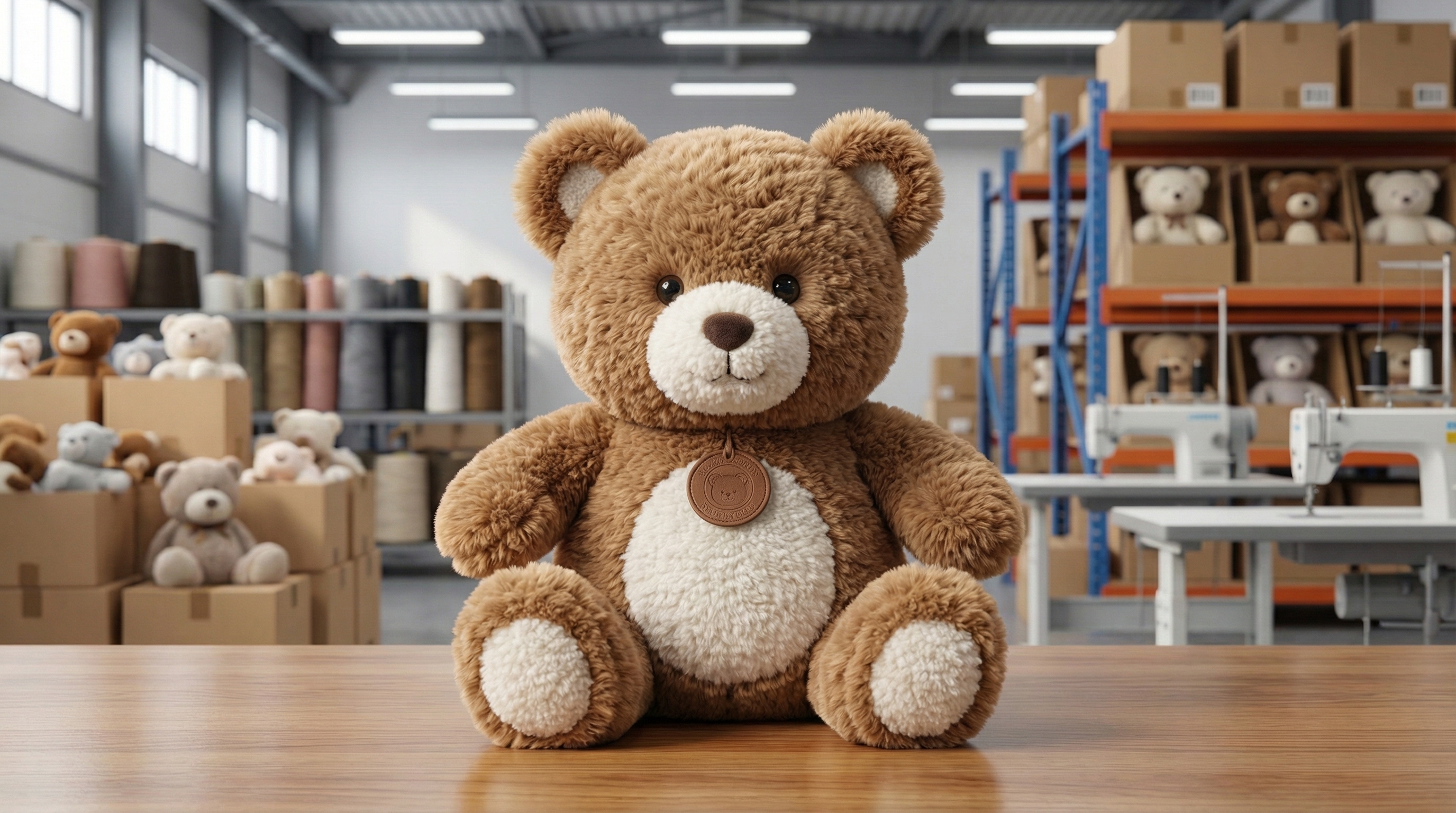
Wholesale teddy bear plush toys ready for bulk shipment — understanding material, fill, and finishing quality at this stage prevents costly returns downstream.
Quick Answer: What Does Teddy Bear Plush Toy Wholesale Actually Involve?
At its core, wholesale plush toy procurement means buying stuffed teddy bears in bulk—typically starting at 500–3,000 units per SKU—from a manufacturer or trading company that can produce to your specifications. The process spans design confirmation → material sourcing → pattern cutting → sewing and stuffing → quality inspection → packing → export logistics. For buyers who need custom shapes, branded embroidery, or specific safety certifications (EN 71, ASTM F963, CPSIA), you're working with a custom teddy bear manufacturer or OEM plush toy supplier rather than buying from open stock.
Typical lead times run 30–60 days from sample approval to shipment, depending on order volume and customization depth. Landed costs for a standard 20–30 cm teddy bear range from $1.20–$4.50 per unit FOB, with the spread driven by material grade, fill density, embroidery complexity, and safety testing requirements.
Buyer Checklist: 8 Non-Negotiable Evaluation Points
Before you request a single quote, use this checklist to filter potential suppliers. It saves weeks of back-and-forth with factories that can't actually deliver what you need.
- Safety certification capability: Can the supplier provide EN 71 (EU), ASTM F963 (US), or GB 6675 (China domestic) test reports from an accredited lab? Ask for recent reports, not just claims.
- MOQ flexibility: True OEM factories often require 1,000–3,000 units per design. If a supplier quotes 50-piece MOQs for "custom" work, they may be reselling stock items with minor modifications.
- Material sourcing transparency: Request the specific fabric type (crystal super-soft, short plush, velboa, minky) and fill material (PP cotton, recycled polyester). Reputable suppliers specify GSM weight for fabric and fill density per unit.
- Sample lead time and cost: A capable custom teddy bear manufacturer typically delivers a pre-production sample in 7–15 days. Sample fees ($50–$150) are standard and often refundable against the production order.
- In-house embroidery and printing: If your design requires logo embroidery, heat-transfer printing, or sublimation, confirm whether this is handled in-house or subcontracted. In-house control means tighter quality.
- Third-party inspection access: Will the factory allow pre-shipment inspection by SGS, Bureau Veritas, or your own QC team? Resistance here is a red flag.
- Packing and inner-box configuration: Confirm polybag specs, hang-tag attachment, carton dimensions, and units per carton. This directly affects your warehouse receiving and retail planogram.
- Export documentation: Commercial invoice, packing list, certificate of origin, and any required fumigation or phytosanitary certificates for your destination market.
Cost Breakdown: What Actually Drives Your Per-Unit Price
Plush toy pricing is less about negotiation leverage and more about understanding the bill of materials. Here's where the money goes:
| Cost Component | % of FOB Price | Key Variables |
|---|---|---|
| Outer fabric | 25–35% | Fabric type, GSM, color count, print method |
| Fill material | 10–15% | PP cotton grade, fill weight per unit, recycled vs. virgin |
| Labor (cutting, sewing, stuffing, finishing) | 25–35% | Number of pattern pieces, embroidery complexity, hand-finishing |
| Accessories | 5–10% | Safety eyes, ribbons, clothing, sound modules |
| Packaging | 5–8% | Polybag, hang tag, display box, retail-ready packaging |
| Testing & compliance | 2–5% | Lab test fees amortized across order volume |
| Factory margin | 8–15% | Order volume, relationship tenure, payment terms |
Key insight: The biggest cost lever isn't haggling on margin—it's optimizing pattern complexity and material selection. Reducing a design from 12 pattern pieces to 8 can cut sewing labor by 20%. Switching from 280 GSM crystal plush to 210 GSM short plush saves 15–20% on fabric cost with minimal perceived quality difference for promotional-grade products.
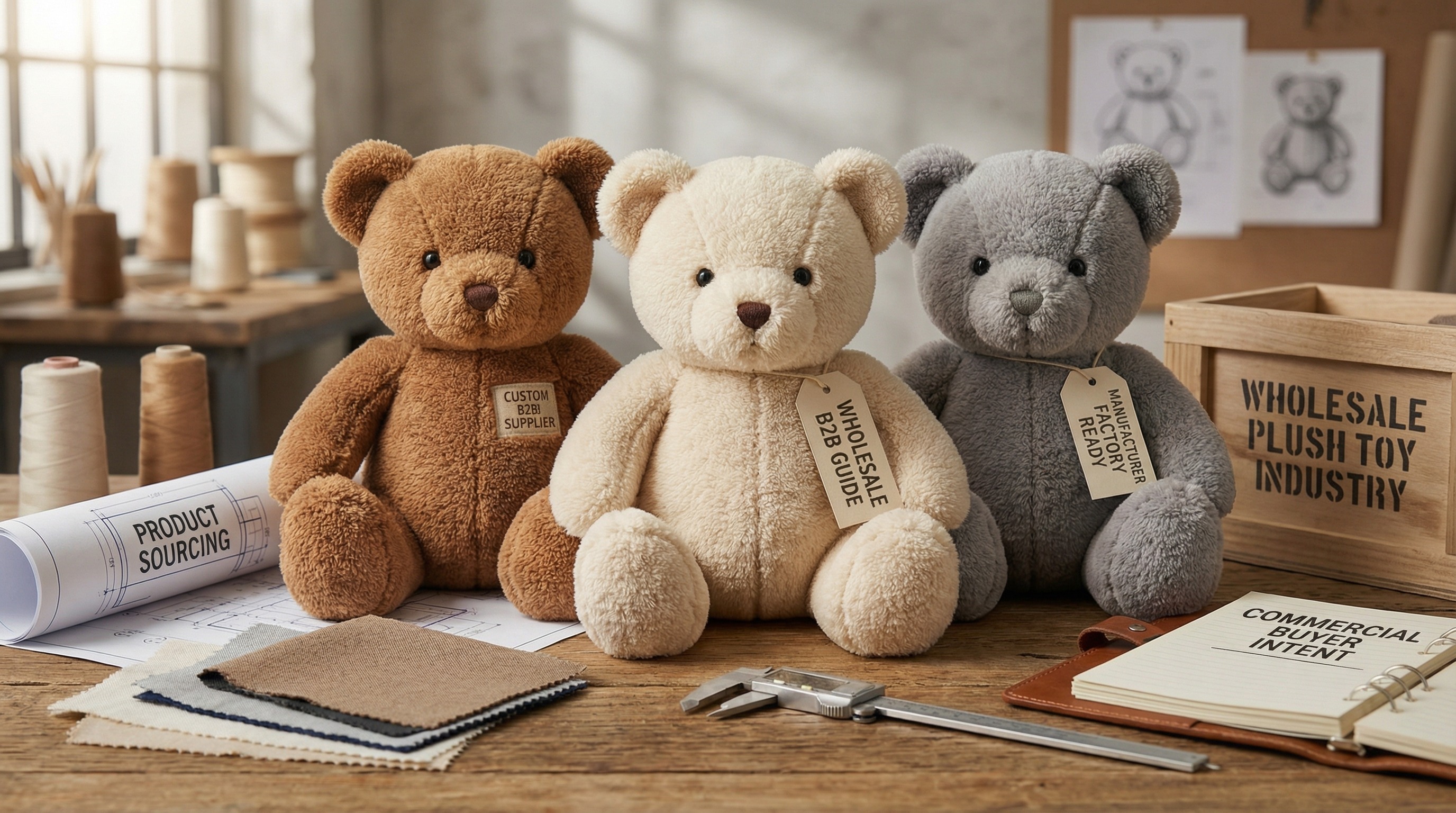
Custom teddy bear production involves precise pattern cutting, material matching, and fill-weight control — each step directly impacts landed cost and perceived quality.
How to Evaluate a Custom Teddy Bear Manufacturer vs. a Trading Company
This distinction matters more than most buyers realize. A custom teddy bear manufacturer owns the production floor—cutting tables, sewing lines, stuffing machines, and QC stations. A trading company brokers between you and one or more factories, adding margin and sometimes adding project management value.
When to work with a direct manufacturer:
- You need deep customization: unique patterns, proprietary fabric, branded packaging
- Your annual volume exceeds 10,000 units across SKUs
- You require factory audit access (BSCI, SEDEX, or customer-specific)
- You want to iterate on samples quickly without intermediary delays
When a trading company or OEM plush toy supplier adds value:
- You're sourcing multiple product categories and want one point of contact
- Your order is below typical factory MOQs and you need consolidation
- You lack in-house QC resources and need the supplier to manage inspection
Either way, request a factory video tour or live video call walkthrough. Legitimate suppliers welcome this. If they deflect, dig deeper before committing funds.
OEM Plush Toy Supplier: The Production Workflow You Should Understand
Knowing the standard OEM workflow helps you ask better questions and set realistic timelines:
- Design brief & quotation (Days 1–3): You provide artwork, dimensions, Pantone colors, and quantity. The supplier returns a detailed quote with material specs.
- Sample development (Days 4–18): A pre-production sample is sewn and shipped for your approval. Expect 1–2 revision rounds.
- Sample approval & deposit (Day 19): You confirm the sample, sign off on a production order, and pay the deposit (typically 30% T/T).
- Material procurement (Days 20–30): The factory orders fabric, fill, eyes, accessories, and packaging materials.
- Bulk production (Days 31–50): Cutting, sewing, stuffing, finishing, and in-line QC. A good factory runs AQL 2.5 inspection at multiple stages.
- Final QC & packing (Days 51–55): Finished units are inspected, packed per your specs, and palletized or loaded into cartons.
- Shipment (Days 56–60): Goods are delivered FOB port or to your freight forwarder. Balance payment (70%) is due against B/L copy or before shipment, per agreement.
For reference, the ASTM F963-23 standard (the current edition of the US toy safety standard maintained by ASTM International) governs mechanical, flammability, and chemical safety requirements for toys sold in the United States. EN 71, maintained by the European Committee for Standardization (CEN), serves the equivalent role for EU markets. Any credible OEM plush toy supplier should be able to produce test reports against these standards from an ISO 17025-accredited laboratory.
Export-ready carton packing with inner polybags, hang tags, and clearly labeled master cartons — proper packaging protects margins and speeds warehouse receiving.
Packaging, Loading, and Delivery Readiness
Plush toys are high-volume, low-weight products. A standard 40HQ container can hold 25,000–40,000 units of a 25 cm teddy bear, depending on compression and carton configuration. Key packaging decisions:
- Individual polybag with suffocation warning (required for US/EU consumer markets)
- Retail-ready display box vs. bulk-pack inner cartons — display packaging adds $0.15–$0.40/unit but eliminates repack labor at your warehouse
- Vacuum compression packing can increase container utilization by 30–40%, significantly reducing per-unit freight cost on large orders
- Master carton labeling: SKU, barcode, quantity, gross/net weight, carton dimensions — confirm this matches your WMS requirements before production
Frequently Asked Questions
What is the typical MOQ for teddy bear plush toy wholesale orders?
For stock designs with minor customization (logo tag, ribbon color), MOQs start around 500 units. Fully custom OEM designs with unique patterns and proprietary fabric typically require 1,000–3,000 units per SKU.
How do I verify a custom teddy bear manufacturer's quality before placing a large order?
Request a pre-production sample, ask for recent third-party test reports (EN 71 or ASTM F963), and arrange a pre-shipment inspection through an independent QC firm. Also ask for references from buyers in your market.
Can I get custom branding on wholesale teddy bears?
Yes. Most OEM plush toy suppliers offer embroidered logos, custom hang tags, branded ribbons, printed t-shirts on the bear, and full custom packaging. Embroidery is the most durable and cost-effective branding method for plush.
What safety certifications should I require?
For the US market, require ASTM F963 and CPSIA compliance (including lead and phthalate testing). For the EU, require EN 71 Parts 1, 2, and 3. For children under 3, additional small-parts and pull-strength testing is mandatory in both jurisdictions.
How can I reduce my per-unit cost without sacrificing quality?
Optimize pattern complexity, consolidate colorways to reduce fabric changeover, increase order volume to amortize tooling and testing costs, and consider vacuum compression packing to lower freight per unit.
Related Solutions Worth Exploring
If you're sourcing plush toys as part of a broader product mix—whether for retail, promotional campaigns, or branded merchandise programs—explore our full product catalog for complementary items. For deeper dives into sourcing strategy, our blog resource center covers related B2B buying guides, including our detailed companion articles on teddy bear wholesale sourcing fundamentals and advanced OEM plush procurement strategies.
Conclusion: Source Smarter, Not Just Cheaper
Successful teddy bear plush toy wholesale procurement isn't about finding the lowest quote on Alibaba—it's about partnering with a custom teddy bear manufacturer or OEM plush toy supplier who can deliver consistent quality, meet your compliance requirements, and scale with your business. Use the checklist above to qualify suppliers, understand the cost structure so you negotiate from knowledge rather than guesswork, and always validate with samples and independent inspection before committing to bulk.
The buyers who build durable supplier relationships in this category are the ones who treat sourcing as a process, not a transaction.
Featured Blogs
Tag: