Teddy Bear Plush Toy Wholesale: The Complete B2B Sourcing & Procurement Guide
Whether you're a gift-shop chain restocking seasonal inventory, a promotional agency sourcing branded giveaways, or an e-commerce brand launching a private-label plush line, finding the right teddy bear plush toy wholesale partner is one of the most consequential sourcing decisions you'll make. Unit economics, safety compliance, lead times, and brand perception all hinge on the manufacturer you choose—and the specifications you lock in before production begins.
This guide breaks down exactly what B2B buyers need to evaluate when sourcing wholesale teddy bears, how to vet a custom teddy bear manufacturer, and what to look for in an OEM plush toy supplier so you can place your next order with confidence.

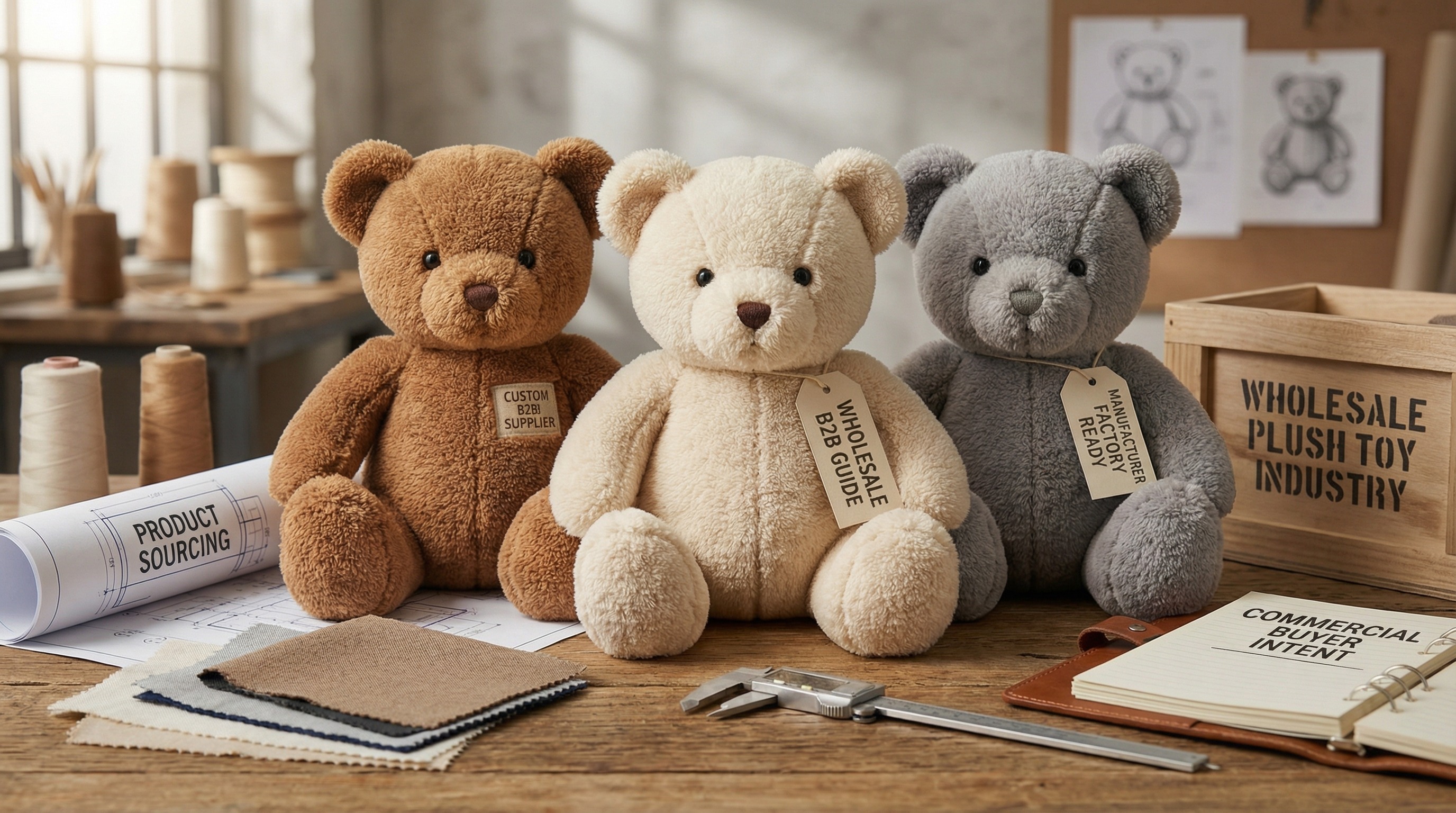
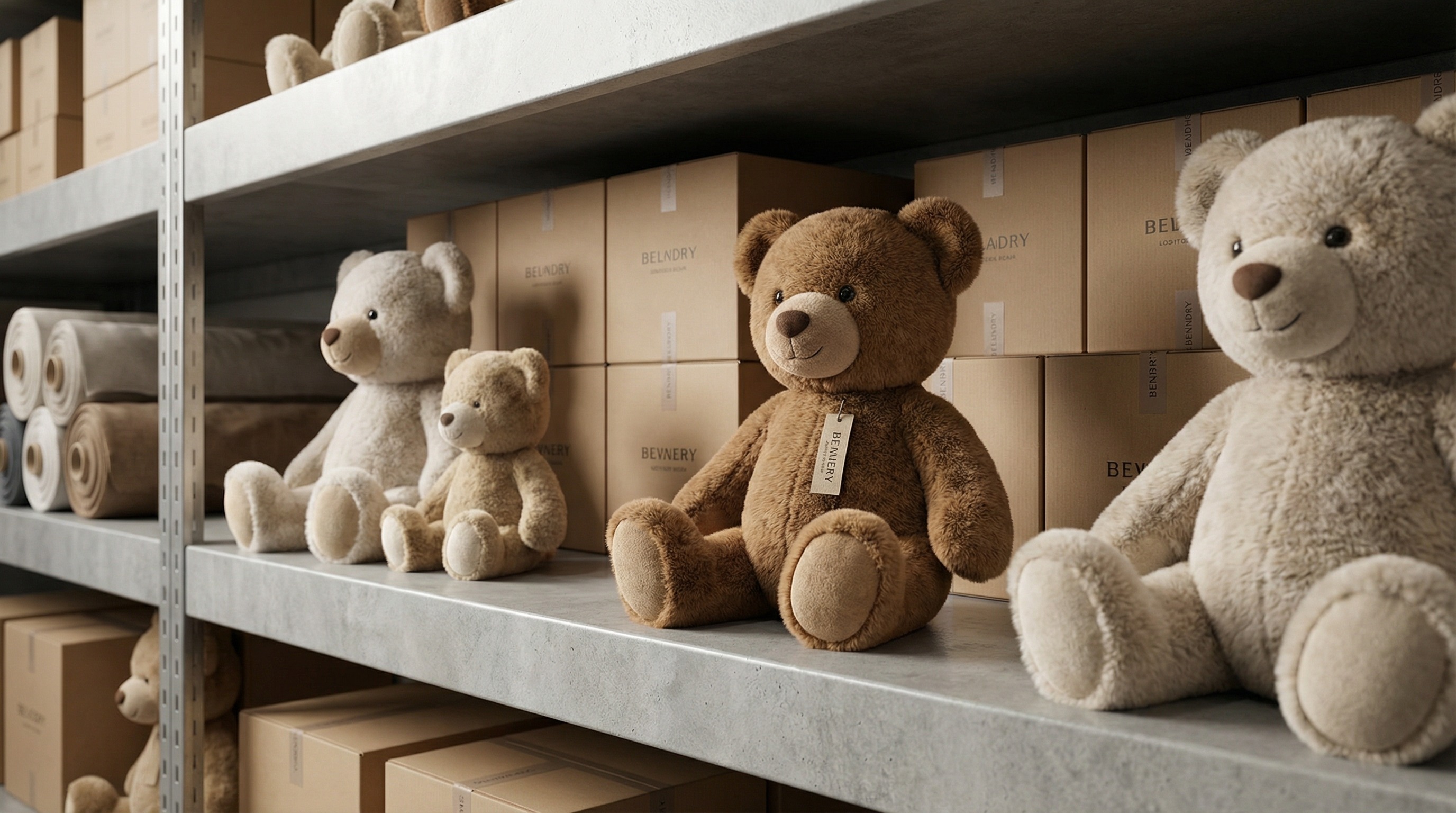
Wholesale teddy bear plush toys ready for bulk shipment — material quality and fill density vary significantly across suppliers.
Quick Answer: What Does Teddy Bear Plush Toy Wholesale Actually Involve?
At its core, wholesale plush procurement means purchasing stuffed teddy bears in bulk—typically starting at 300–500 units per SKU—directly from a manufacturer or authorized distributor. Orders can range from off-the-shelf catalog designs to fully custom OEM projects with bespoke patterns, branded packaging, and region-specific safety certifications.
The critical variables that separate a smooth order from a costly mistake include:
- Material selection — crystal super-soft, short plush, minky, organic cotton
- Fill type — PP cotton, recycled polyester, weighted pellets
- Safety compliance — EN 71 (EU), ASTM F963 (US), GB 6675 (China), CPSIA
- MOQ and pricing tiers — unit cost drops significantly at 1,000, 3,000, and 10,000+ pieces
- Customization depth — embroidery, sublimation printing, hang tags, custom poly bags or gift boxes
The Buyer Checklist: 8 Points to Verify Before You Order
Use this checklist as a non-negotiable gate before committing to any OEM plush toy supplier. Each point addresses a real-world failure mode that procurement teams encounter regularly.
- Factory audit status — Request a current BSCI, Sedex, or ISO 9001 certificate. A credible custom teddy bear manufacturer will share these proactively.
- Material safety test reports — Ask for third-party lab reports (SGS, Bureau Veritas, Intertek) covering phthalates, lead, flammability, and small-parts testing per your target market's standard.
- Sample turnaround — A reliable supplier delivers a pre-production sample within 7–15 days. If it takes longer, production timelines will likely slip too.
- Embroidery & printing capability — Confirm whether logo placement uses machine embroidery, heat transfer, or woven labels. Each has different durability and cost implications.
- MOQ flexibility — Some factories quote 500-piece MOQs but only deliver competitive pricing at 3,000+. Get the full pricing ladder upfront.
- Packing & inner-box configuration — Verify units per carton, carton dimensions, and gross weight to calculate accurate shipping costs before you commit.
- Production lead time — Standard bulk runs take 25–45 days after sample approval. Rush orders (15–20 days) usually carry a 10–15% surcharge.
- Payment terms — Industry standard is 30% deposit / 70% before shipment. T/T, L/C, and trade-assurance escrow are all common.
If a supplier can't answer all eight points clearly in the first round of communication, treat that as a red flag—not a negotiation starting point.
Cost & Value Breakdown: What Drives Wholesale Teddy Bear Pricing?
Price per unit is the number every buyer fixates on, but the total landed cost is what actually determines your margin. Below is a realistic cost structure for a 25 cm custom teddy bear at different order volumes.
| Cost Component | 500 Units | 3,000 Units | 10,000 Units |
|---|---|---|---|
| Unit FOB price (crystal super-soft, PP cotton fill) | $3.20 – $4.00 | $2.40 – $3.00 | $1.80 – $2.30 |
| Custom embroidery (one-position logo) | +$0.30 | +$0.15 | +$0.08 |
| Custom hang tag & poly bag | +$0.20 | +$0.12 | +$0.07 |
| Mold / pattern setup (one-time) | $150 – $300 | $150 – $300 | $150 – $300 |
| Third-party lab testing (per SKU) | $200 – $500 | $200 – $500 | $200 – $500 |
| Estimated landed unit cost (sea freight to US port) | $4.50 – $5.80 | $3.20 – $4.00 | $2.30 – $3.00 |
Key takeaway: The jump from 500 to 3,000 units typically delivers a 25–35% unit-cost reduction. For most B2B buyers, the 3,000-unit tier represents the best balance of inventory risk and margin optimization.

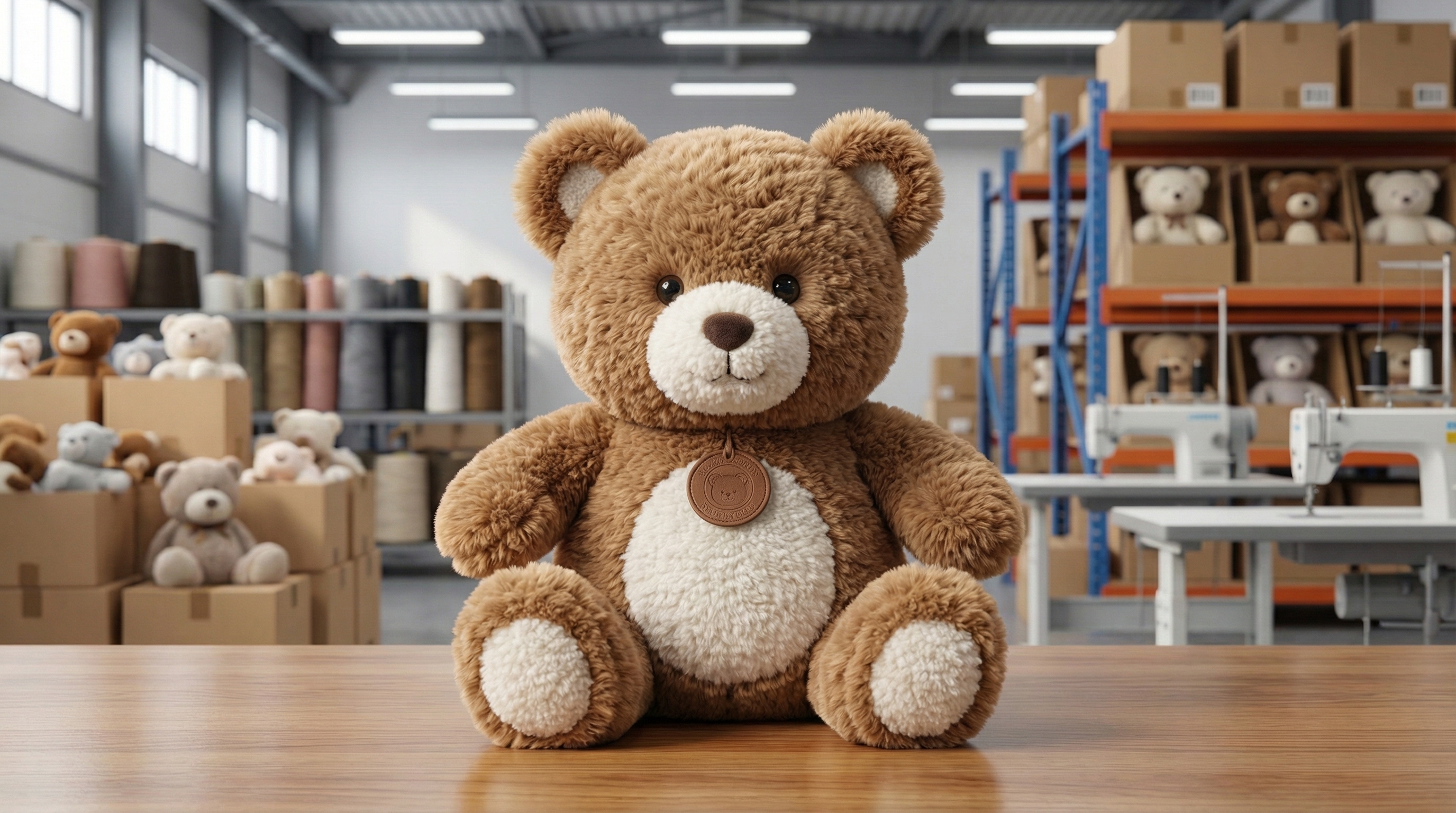
Custom teddy bears in production — embroidered logos and branded packaging add minimal per-unit cost at volume.
How to Evaluate a Custom Teddy Bear Manufacturer
Not every factory that calls itself a custom teddy bear manufacturer actually runs its own cutting, sewing, and stuffing lines. Many are trading companies that subcontract production, which adds cost layers and reduces your quality control visibility. Here's how to distinguish the two:
Direct Factory Indicators
- Provides factory floor photos or video walkthroughs on request
- Owns pattern-making and die-cutting equipment
- Employs in-house QC staff and can share AQL inspection reports
- Offers on-site visits or third-party factory audits
Trading Company Indicators
- Catalogs span dozens of unrelated product categories
- Cannot specify which factory will handle your order
- Reluctant to share production-line photos or audit certificates
- Lead times are vague or inconsistent across order sizes
Neither model is inherently wrong—some trading companies add value through multi-category sourcing and logistics coordination. But if your priority is tight quality control and design confidentiality for an OEM plush line, a direct factory relationship is almost always preferable.
OEM Plush Toy Supplier: The Production Workflow
Understanding the standard OEM workflow helps you set realistic timelines and catch problems early. A typical custom teddy bear project follows this sequence:
- Design brief & quotation (Day 1–3) — You provide reference images, size specs, material preferences, logo files, and target price. The supplier returns a detailed quote.
- Pattern development (Day 4–10) — The factory creates a 2D pattern and cuts a first sample. Expect 1–2 revision rounds.
- Sample approval (Day 11–18) — You receive a physical counter sample by express courier. Confirm dimensions, color, stitching, fill density, and branding placement.
- Pre-production meeting (Day 19–21) — Finalize BOM (bill of materials), packing specs, labeling, and compliance requirements. Deposit is paid.
- Bulk production (Day 22–50) — Cutting, sewing, stuffing, finishing, QC inspection. Mid-production photos should be standard.
- Final inspection & shipment (Day 51–55) — AQL 2.5 inspection (per ISO 2859-1), balance payment, and booking of freight.
Total cycle from brief to shipment: roughly 50–60 days for a first order. Repeat orders with approved patterns can ship in 30–40 days.
Packaging, Labeling & Export Readiness
Packaging is often an afterthought—until a customs hold or retailer chargeback makes it a priority. For teddy bear plush toy wholesale shipments, ensure your supplier covers:
- Individual poly bags with suffocation warning text (required for US and EU markets)
- Care labels sewn into the seam with fiber content, country of origin, and importer info
- Master cartons rated for export stacking — five-layer corrugated is standard
- Shipping marks with PO number, carton count, and destination port
- Fumigation certificates if wooden pallets are used (ISPM-15 compliance)
For buyers selling into the EU, ensure CE marking and the EN 71 test suite (Parts 1, 2, and 3) are completed before goods leave the factory. The US market requires CPSIA compliance and a Children's Product Certificate (CPC) based on ASTM F963 testing. These are not optional—non-compliant shipments can be seized at the border.

Explore our full product catalog and sourcing capabilities for wholesale and OEM inquiries.
Frequently Asked Questions
What is the typical MOQ for teddy bear plush toy wholesale orders?
Most factories set MOQs between 300 and 500 units per design for custom orders. Catalog (stock) designs may be available at lower minimums of 100–200 pieces, though customization options will be limited.
How do I verify that a custom teddy bear manufacturer meets safety standards?
Request third-party test reports from accredited labs such as SGS, Intertek, or TÜV. For the US market, confirm ASTM F963 and CPSIA compliance. For the EU, require EN 71 Parts 1–3 testing. A credible manufacturer will have current reports on file and can commission new tests for your specific product.
Can I order mixed sizes or designs in one shipment?
Yes, but each unique design or size typically needs to meet the per-SKU MOQ. Consolidating multiple SKUs into one shipment is standard practice and helps reduce freight costs per unit.
What's the difference between an OEM plush toy supplier and an ODM supplier?
OEM means the factory produces to your exact design and specifications. ODM means the factory offers existing designs that you can rebrand or modify. OEM gives you full design ownership; ODM is faster and cheaper for buyers who don't need a unique pattern.
How much does custom embroidery add to the unit cost?
Single-position embroidery (e.g., chest logo) typically adds $0.08–$0.30 per unit depending on stitch count and order volume. Multi-color or large-area embroidery costs more. Heat-transfer printing is a lower-cost alternative for complex graphics.
Related Solutions & Resources
If you're expanding your sourcing scope beyond plush toys, explore these related resources:
- Browse Our Full Product Catalog — discover additional wholesale and OEM-ready product lines.
- Teddy Bear Plush Toy Wholesale: The Complete B2B Sourcing Guide — our companion deep-dive on supplier vetting and negotiation tactics.
- Visit Our Blog — procurement guides, industry insights, and product spotlights updated regularly.
Conclusion: Source Smarter, Not Just Cheaper
The teddy bear plush toy wholesale market is crowded with suppliers competing on price—but the lowest quote rarely delivers the lowest total cost. Compliance failures, inconsistent fill quality, missed ship dates, and poor packaging can erode margins far more than a $0.20 unit-price difference.
The buyers who win in this category are the ones who invest time upfront: verifying factory capabilities, locking in material specs, confirming safety