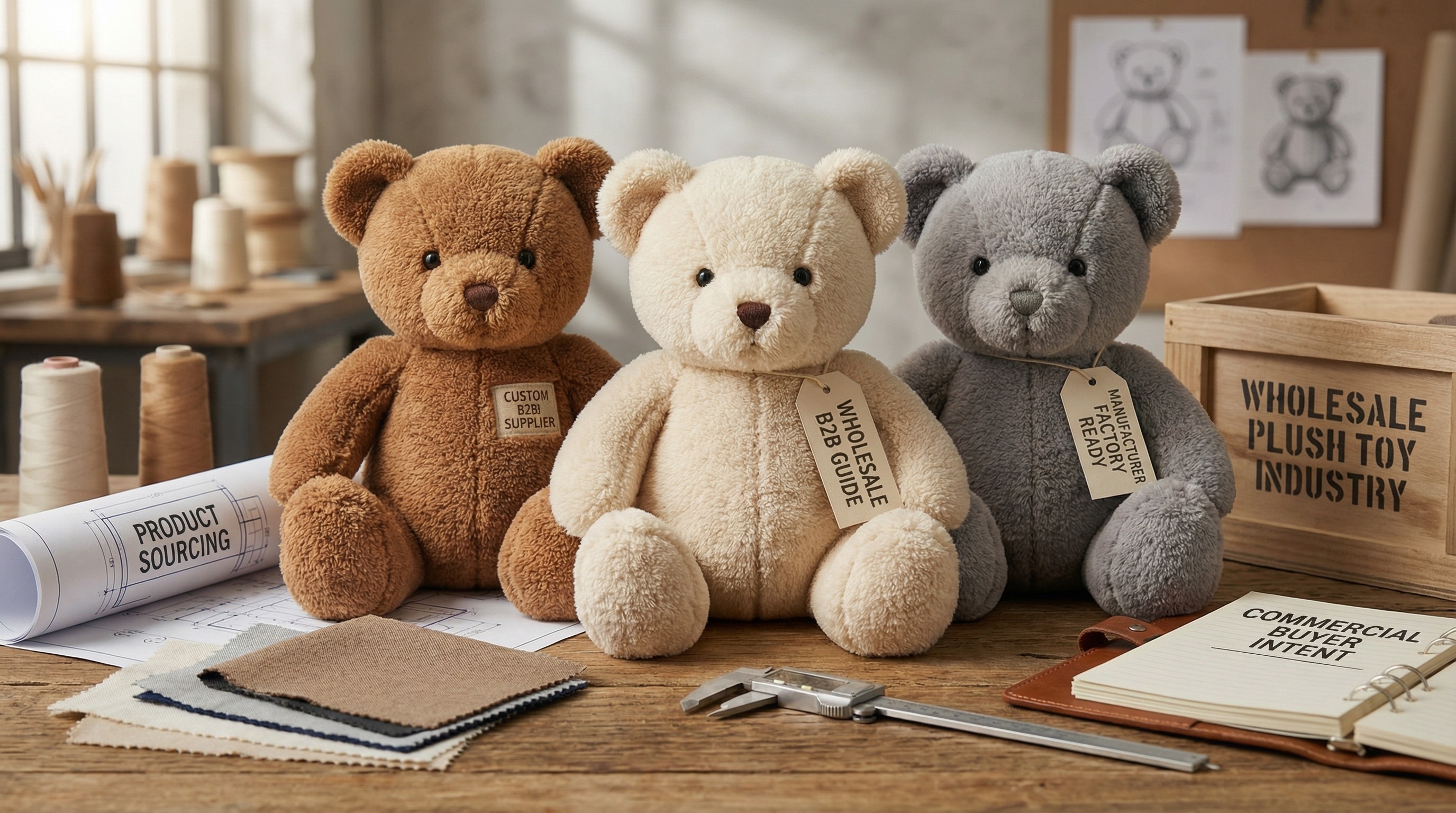
Teddy Bear Plush Toy Wholesale: The Industrial Sourcing Guide for B2B Buyers
For retailers, promotional agencies, and brand owners sourcing soft toys at volume, teddy bear plush toy wholesale remains one of the most consistently demanded product categories in the global gift and toy market. Yet the gap between placing an order and receiving a shipment that actually meets your brand standards, safety certifications, and margin targets is wider than most first-time buyers expect.
This guide walks procurement teams through the real decision points—from qualifying a custom teddy bear manufacturer to negotiating MOQs, validating safety compliance, and structuring an OEM program that scales. Whether you're stocking an e-commerce catalog, building a licensed character line, or sourcing branded giveaways, the framework below will help you buy smarter and avoid the most expensive mistakes.

Wholesale teddy bear plush toys ready for quality inspection before bulk shipment.
Quick Answer: What Does Teddy Bear Plush Toy Wholesale Actually Involve?
At its simplest, wholesale plush procurement means purchasing stuffed teddy bears in bulk—typically 500 to 50,000+ units per order—at per-unit prices significantly below retail. But in practice, most B2B buyers aren't purchasing generic stock. They need some degree of customization: branded hang tags, specific Pantone colors, embroidered logos, or entirely original designs produced through an OEM plush toy supplier.
The typical wholesale engagement follows this sequence:
- Design brief or sample selection — You supply artwork, a reference sample, or choose from the factory's existing mold library.
- Pre-production sample (PPS) — The manufacturer produces 1–3 approval samples for fit, color, and construction review.
- Production run — After PPS approval, bulk manufacturing begins (lead times typically 30–60 days).
- Quality inspection — In-line and final random inspections against AQL standards before shipment.
- Packaging and export — Polybag, display box, or custom retail packaging, consolidated into cartons for FCL or LCL shipping.
Understanding this workflow upfront prevents the most common sourcing delays: late sample revisions, unclear material specs, and packaging mismatches that trigger chargebacks at destination.
Buyer Checklist: How to Qualify a Custom Teddy Bear Manufacturer
Not every plush factory is equipped for every order type. A facility optimized for carnival-prize bears at $0.80 per unit operates very differently from one producing licensed collectibles at $8.00. Use this checklist before committing to a supplier:
- Safety certifications: Confirm current EN 71 (EU), ASTM F963 (US), or GB 6675 (China domestic) test reports. Ask for the testing lab name and report date—not just a claim on the website.
- Material sourcing: Verify whether the factory uses new polyester fiber fill (virgin PP cotton) or recycled fill. For eco-conscious brands, ask about GRS-certified recycled polyester or organic cotton shells.
- OEM capability: Can the factory work from a 2D sketch, a 3D rendering, or only from a physical reference sample? Top-tier suppliers maintain in-house pattern-making and digital sculpting teams.
- MOQ flexibility: Stock designs may start at 200–500 pieces. Fully custom OEM designs typically require 1,000–3,000 units minimum.
- Embroidery and printing: Check whether embroidery, heat-transfer printing, and sublimation are done in-house or subcontracted. In-house capability means tighter quality control.
- Social compliance: For major retail channels, BSCI, SEDEX, or ICTI Ethical Toy Program audits may be required. Confirm audit status before sampling.

Evaluating plush construction quality—stitch density, seam strength, and fill consistency are critical checkpoints.
Cost and Value: What Drives Wholesale Plush Pricing?
Per-unit cost for wholesale teddy bears can range from under $1.00 to over $15.00 depending on a handful of variables. Understanding these drivers helps you negotiate realistically and avoid quoting surprises.
| Cost Driver | Low-Cost Range | Mid-Range | Premium Range |
|---|---|---|---|
| Size | 15–20 cm (keychain bears) | 25–40 cm (standard gift) | 50–120 cm (jumbo display) |
| Shell Fabric | Short-pile polyester | Crystal super-soft / minky | Organic cotton, alpaca-feel |
| Fill Material | Standard PP cotton | Weighted pellets + PP cotton | GRS recycled polyester fill |
| Customization | Hang tag only | Embroidered logo + custom color | Full OEM design from sketch |
| Typical FOB Price | $0.60–$1.50 | $2.00–$5.00 | $6.00–$15.00+ |
Key insight: Tooling and mold charges for a fully custom OEM design typically run $200–$800 as a one-time setup cost. This is amortized over your first order, so higher MOQs dramatically reduce the per-unit impact. If your OEM plush toy supplier quotes no tooling fee at all, they're likely adapting an existing pattern rather than building from scratch—which may or may not meet your design intent.
Evaluating OEM Plush Toy Suppliers: Stock vs. Semi-Custom vs. Full OEM
Choosing the right engagement model depends on your timeline, budget, and brand requirements. Here's how the three main approaches compare:
Stock / Catalog Selection
You choose from the factory's existing teddy bear designs and add branded packaging or hang tags. Fastest lead time (2–3 weeks), lowest MOQ, but limited differentiation. Suitable for promotional giveaways or market testing.
Semi-Custom
You modify an existing design—changing fabric color, adding an embroidered logo, adjusting size, or swapping accessories. Lead time 4–6 weeks. This is the sweet spot for most wholesale buyers who need brand presence without full development cost.
Full OEM / ODM
The custom teddy bear manufacturer develops your design from concept art or a reference sample. You own the design. Lead time 6–10 weeks including sampling. Required for licensed characters, proprietary brand mascots, or retail-exclusive collections.
For buyers exploring broader product sourcing strategies, our complete B2B sourcing guide for teddy bear plush toys covers supplier vetting in greater depth, including factory audit frameworks and payment term structures.
OEM production line: from pattern cutting through assembly, stuffing, and final hand-finishing.
Quality Control and Safety Compliance
Plush toys are subject to some of the strictest consumer product safety regulations globally because their primary end users are children. The two most referenced standards are:
- ASTM F963-23 (US Consumer Product Safety Improvement Act) — Covers flammability, small parts, lead and phthalate content, and mechanical hazards.
- EN 71-1/2/3 (European Toy Safety Directive) — Addresses mechanical/physical properties, flammability, and migration of certain chemical elements.
A credible supplier will provide third-party test reports from accredited labs such as SGS, Bureau Veritas, or Intertek—not just self-declarations. Always request reports dated within the last 12 months and matched to the specific materials used in your order.
In-process QC checkpoints worth specifying in your purchase agreement:
- Incoming fabric and fill material inspection
- Stitch density check (minimum 10 stitches per inch for child-safe seams)
- Pull-test on eyes, noses, and attached accessories (≥ 90N per EN 71)
- Metal detector pass on finished units (needle-free guarantee)
- Final random inspection per AQL 2.5 general inspection level II
Packaging, Loading, and Delivery Readiness
Plush toys are volumetric—they take up disproportionate shipping space relative to their weight. Smart packaging decisions directly impact your landed cost:
- Vacuum compression: Reduces carton volume by 40–60% for standard-fill bears. Not suitable for premium long-pile or shaped designs that lose form under compression.
- Individual polybag + master carton: Standard for wholesale. Typical carton holds 24–100 pieces depending on size.
- Retail-ready packaging: Display boxes, window boxes, or hang-card packaging add $0.15–$0.80 per unit but eliminate repacking at your warehouse.
For FCL (full container load) shipments, a 40HQ container typically holds 2,000–8,000 medium-sized teddy bears depending on compression. Your supplier should provide a packing list and container loading plan before production starts.
Frequently Asked Questions
What is the typical MOQ for teddy bear plush toy wholesale?
For stock designs with minor branding, expect MOQs of 200–500 units. Fully custom OEM designs usually require 1,000–3,000 pieces minimum, though some factories accept lower quantities at a higher per-unit price.
How long does it take to produce a custom teddy bear order?
Including sample approval, plan for 6–10 weeks for full OEM orders and 3–5 weeks for semi-custom or catalog selections. Rush production is sometimes available at a 10–15% premium.
Can I get a sample before committing to a bulk order?
Yes. Reputable manufacturers provide pre-production samples (PPS) for $30–$150 per design depending on complexity. Sample cost is often refundable against the first bulk order.
What certifications should I require from an OEM plush toy supplier?
At minimum, ASTM F963 for the US market and EN 71 for Europe. For major retail channels, also verify CPSIA compliance (US), REACH (EU), and social compliance audits like BSCI or ICTI.
How do I protect my custom design from being sold to other buyers?
Include an exclusivity and NDA clause in your purchase agreement. Register your design IP in your home market. Some factories will sign mold-ownership agreements confirming the tooling belongs to you.
Related Solutions Worth Exploring
If you're building a diversified product catalog alongside plush toys, explore our broader product range for complementary wholesale items. For deeper sourcing insights across categories, our resource blog covers procurement best practices, supplier evaluation frameworks, and industry trend analysis.
Conclusion: Source Teddy Bear Plush Toys with Confidence
Successful teddy bear plush toy wholesale sourcing comes down to three things: qualifying the right custom teddy bear manufacturer for your order profile, defining clear material and safety specifications upfront, and structuring your OEM plush toy supplier relationship with proper sampling, inspection, and packaging protocols. Skip any of these steps and you risk delays, compliance failures, or margin erosion that no unit-price discount can offset.
The buyers who consistently get the best results treat their plush supplier as a production partner—not just a vendor. Share your brand standards early, invest in proper sampling, and