Teddy Bear Plush Toy Wholesale: The Complete B2B Sourcing & Procurement Guide
For retail buyers, promotional planners, and corporate gift coordinators, teddy bear plush toy wholesale remains one of the highest-volume, highest-margin categories in the soft goods trade. Yet the gap between placing a bulk order and receiving shelf-ready product that meets safety standards, brand guidelines, and margin targets is wider than most first-time buyers expect.
This guide walks you through the entire procurement cycle—from evaluating an OEM plush toy supplier to managing in-line quality checks and planning delivery logistics. Whether you need 500 units for a holiday campaign or 50,000 for a national retail rollout, the frameworks below will help you source smarter, negotiate better, and avoid the most common pitfalls in the wholesale plush toy industry.

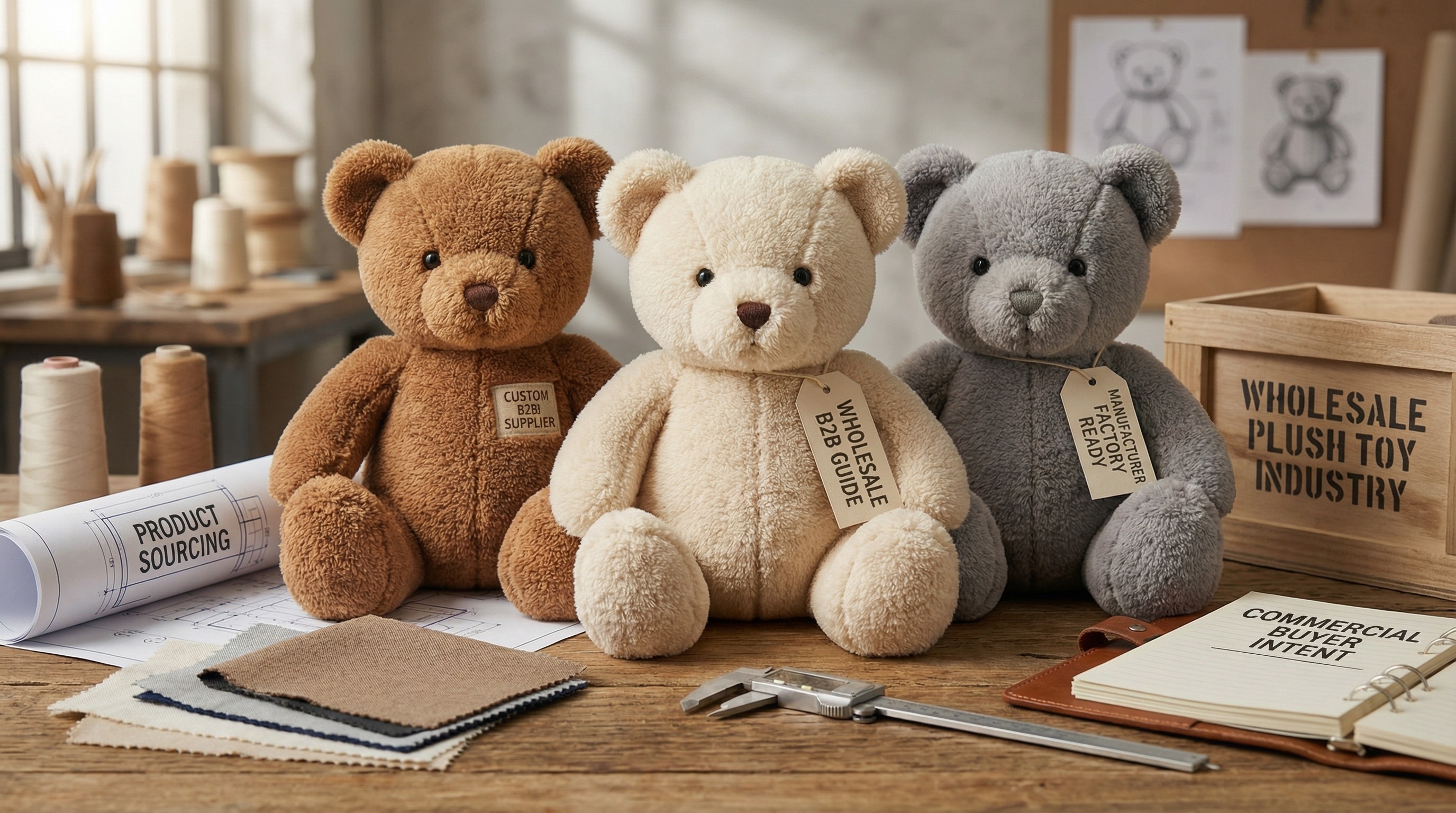
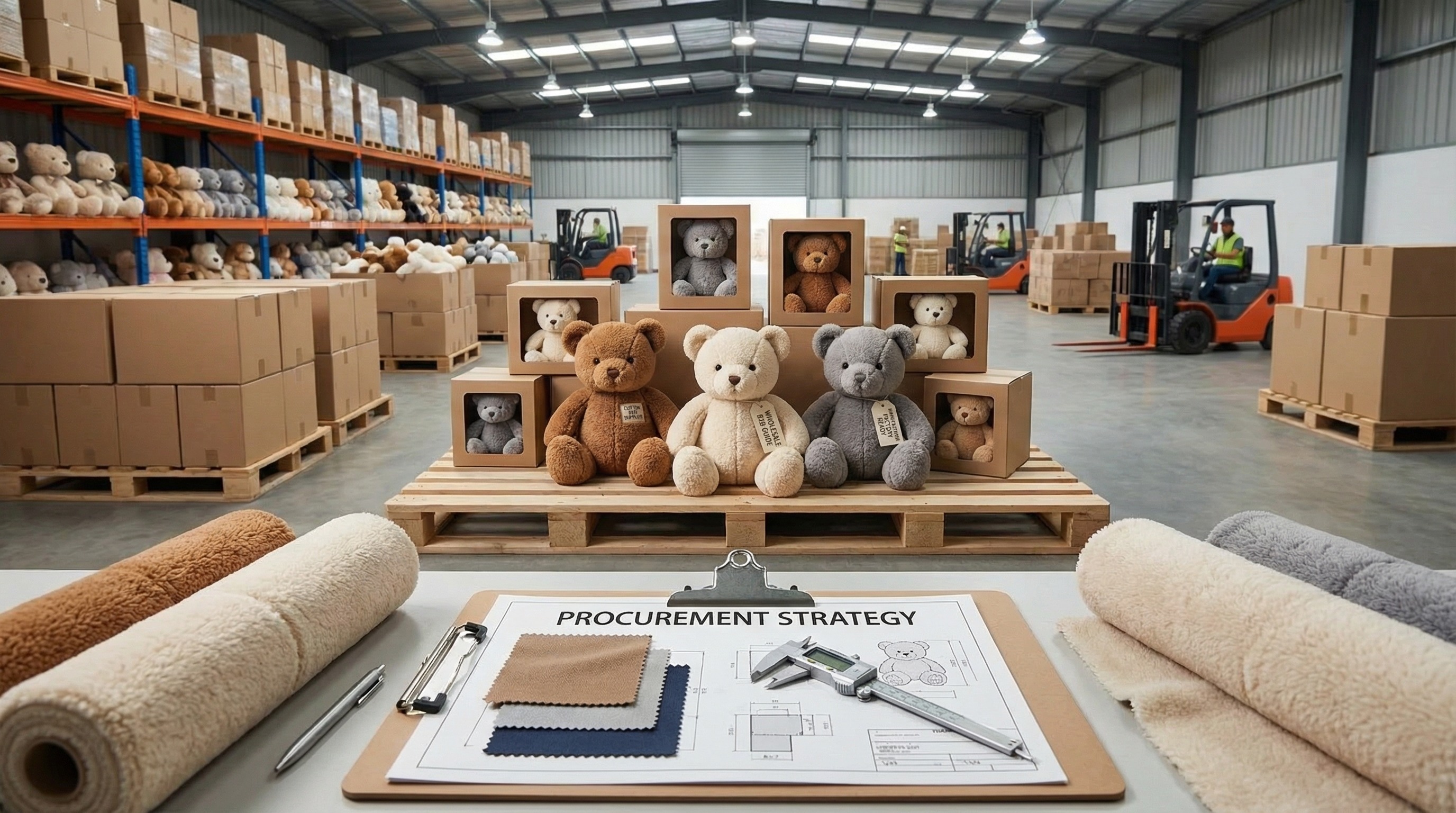
A range of wholesale teddy bear plush toys staged for B2B buyer evaluation—size, fabric, and fill variations at a glance.
Quick Answer: What Does a Bulk Teddy Bear Order Actually Involve?
A typical bulk teddy bear order follows a five-stage pipeline: design brief → sample approval → production run → quality inspection → packaging and shipment. Lead times range from 25–60 days depending on order size, customization complexity, and the supplier's current production load. Unit costs generally fall between $1.50 and $8.00 for standard sizes (15–40 cm), with significant price breaks above 3,000 units.
The real cost of a bad sourcing decision isn't the per-unit price—it's the rework, the delayed launch, or the safety recall. The sections below are designed to help you prevent all three.
Buyer Checklist: Evaluating a Custom Teddy Bear Manufacturer
Not every factory that lists "plush toys" in its catalog has the manufacturing capabilities to deliver consistent quality at scale. Use this checklist before committing to any supplier:
- Certifications: Confirm EN 71 (EU toy safety), ASTM F963 (US), and ISO 8124 compliance. Ask for current test reports, not just logos on a website.
- In-house design team: A genuine custom teddy bear manufacturer should be able to translate a 2D sketch or brand guideline into a 3D sample within 7–15 days.
- Material sourcing transparency: Request fabric composition sheets (polyester plush, organic cotton, recycled PET) and fill specifications (PP cotton weight per unit, hypoallergenic certification).
- Production capacity: Verify monthly output. A mid-size plush factory handles 30,000–80,000 units/month; larger operations exceed 150,000.
- QC infrastructure: Look for in-line inspection at 30% and 70% completion, plus a final random inspection per AQL 2.5 standards.
- References: Ask for two or three verifiable B2B clients in your target market.
If a supplier hesitates on any of these points, treat it as a red flag—not a negotiation tactic.

Teddy bear plush toys in retail, promotional, and corporate gift application settings—versatility drives wholesale demand.
Application Fields: Where Bulk Teddy Bears Create Commercial Value
Understanding end-use helps you specify the right product tier and avoid over- or under-engineering your order. The wholesale plush toy industry serves several distinct channels:
- Children's retail (toy stores, department stores, e-commerce): Requires full safety certification, durable stitching, washable fabrics, and retail-grade hang tags. Typical order: 3,000–30,000 units.
- Promotional & event marketing: Branded bears for trade shows, product launches, or loyalty programs. Emphasis on logo accuracy, fast turnaround, and cost control. Typical order: 1,000–10,000 units.
- Corporate gifting & hospitality: Premium feel, custom packaging (gift boxes, ribbon wraps), and sometimes individual personalization. Typical order: 500–5,000 units.
- Charity & healthcare: Hospitals, first-responder programs, and NGOs sourcing comfort toys. Hypoallergenic fill and flame-retardant fabrics may be mandatory.
- Amusement & claw machines: High-volume, cost-optimized designs with bright colors and exaggerated proportions. Typical order: 10,000+ units.
Cost & Value Decision Matrix
Price alone is a poor basis for product sourcing decisions. The table below maps common order profiles against the variables that actually determine landed cost and commercial return.
| Order Profile | Typical MOQ | Unit Cost Range (FOB) | Key Cost Drivers | Lead Time |
|---|---|---|---|---|
| Standard catalog bear (20–30 cm) | 500–1,000 pcs | $1.80–$3.50 | Fabric grade, fill weight | 20–30 days |
| Custom OEM bear with logo embroidery | 1,000–3,000 pcs | $2.50–$5.00 | Embroidery complexity, Pantone matching, sample iterations | 30–45 days |
| Premium gift bear with custom packaging | 500–2,000 pcs | $4.00–$8.00 | Box/ribbon packaging, fabric hand-feel, accessories | 35–50 days |
| High-volume amusement / promo bear | 5,000–50,000 pcs | $1.50–$2.80 | Volume discount, simplified design, polybag packing | 30–60 days |
Key insight: Tooling or mold fees for a fully custom shape typically run $200–$600 one-time and are often waived above 5,000 units. Always confirm this in writing during the quotation stage.
OEM Production Workflow: From Brief to Bulk Shipment
Working with an experienced OEM plush toy supplier follows a predictable workflow. Here's what to expect—and where to intervene—at each stage:
1. Design Brief & Quotation (Days 1–5)
Submit your target size, color (Pantone references preferred), fabric preference, fill type, logo placement, and packaging requirements. A professional supplier returns a detailed quotation within 2–5 business days, including unit price tiers by quantity, tooling or setup fees, and estimated lead time.
2. Sample Development (Days 6–20)
Expect 7–15 days for a pre-production sample. Evaluate fabric hand-feel, color accuracy, stitching quality, embroidery sharpness, and overall proportion. Approve in writing before production begins—this approved sample becomes your quality benchmark for the entire run.
3. Bulk Production & In-Line Inspection (Days 21–50)
During production, request in-line quality checks at 30% and 70% completion. Key checkpoints include seam strength, fill weight consistency, color batch uniformity, and eye/nose attachment security (critical for child safety per ASTM F963 and EN 71 small-parts requirements). According to ISO 2859-1, a standard AQL 2.5 sampling plan is widely used in the plush toy industry for final random inspection.
4. Packaging & Loading
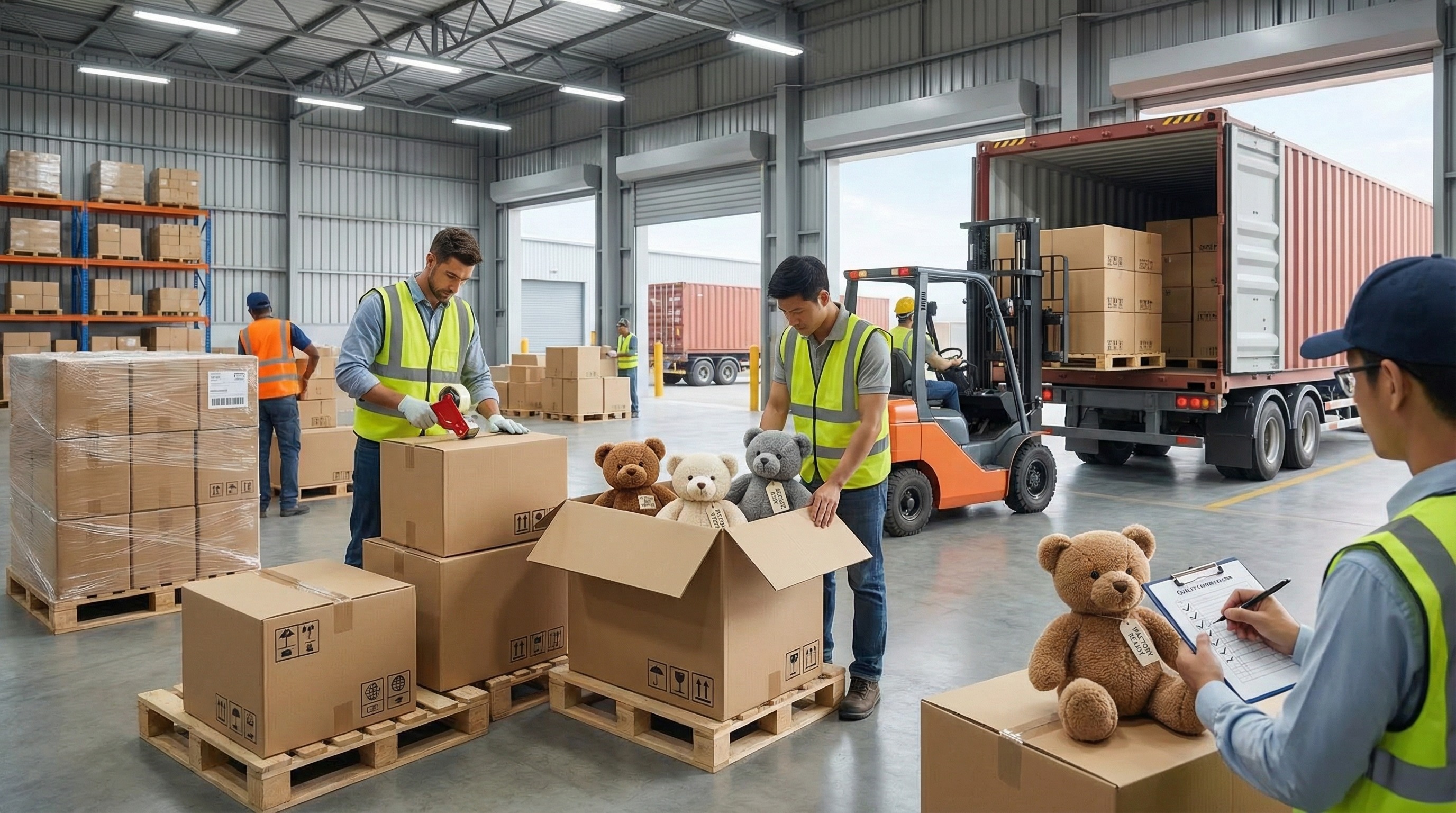
Standard options include individual polybag with header card, window-front display box, or bulk carton packing. Confirm carton dimensions and gross weight early—this directly affects your shipping cost. A standard 40-ft container holds approximately 2,000–2,500 master cartons of small-to-medium plush toys, depending on compression.
5. Shipment & Delivery
Sea freight from major manufacturing hubs to North American or European ports runs 18–35 days. For urgent orders under 2,000 units, air freight or rail-sea hybrid routes can cut transit by 50% at a higher per-kilo cost. Factor customs clearance and any required safety testing at the destination port into your timeline.

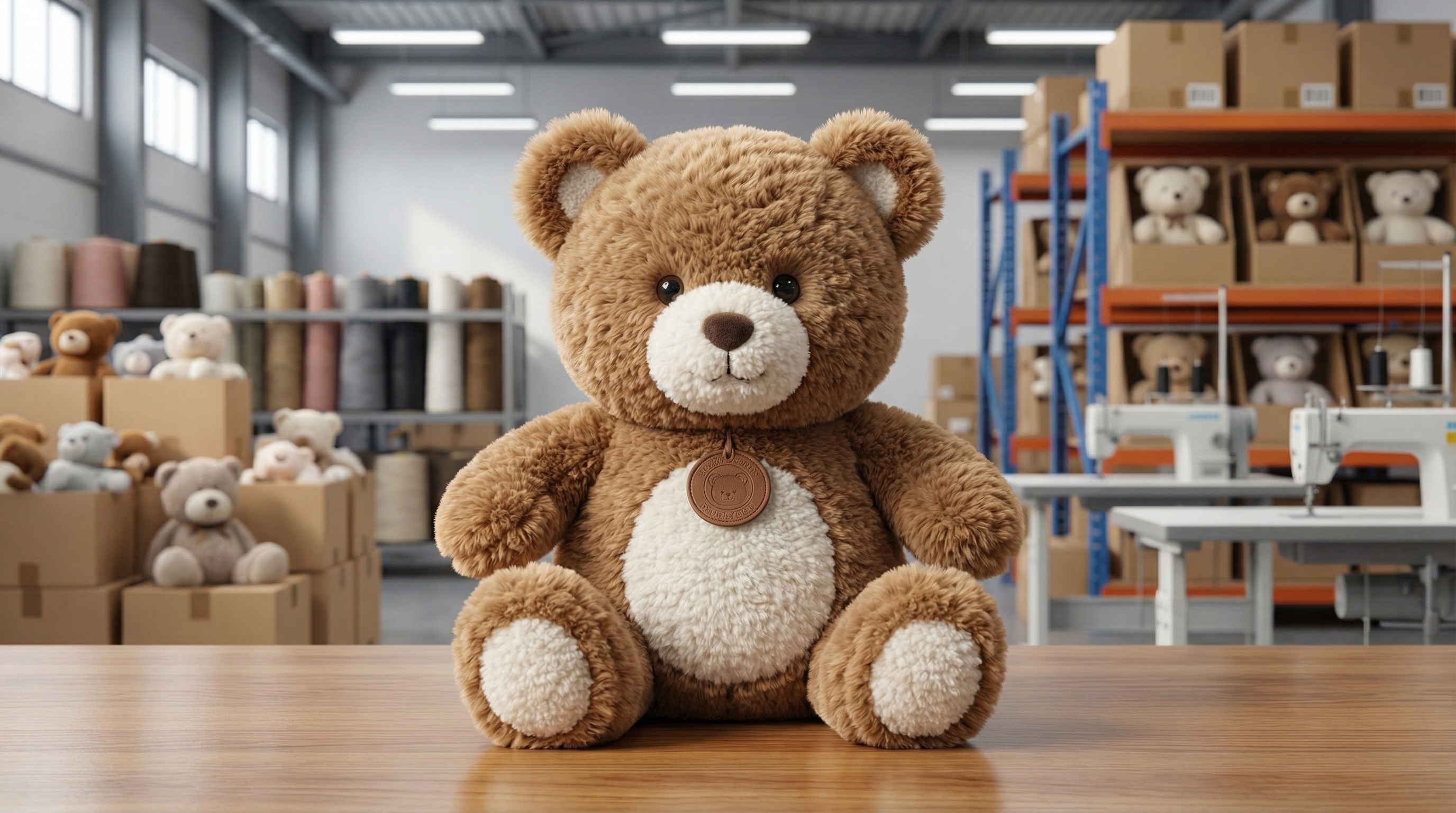
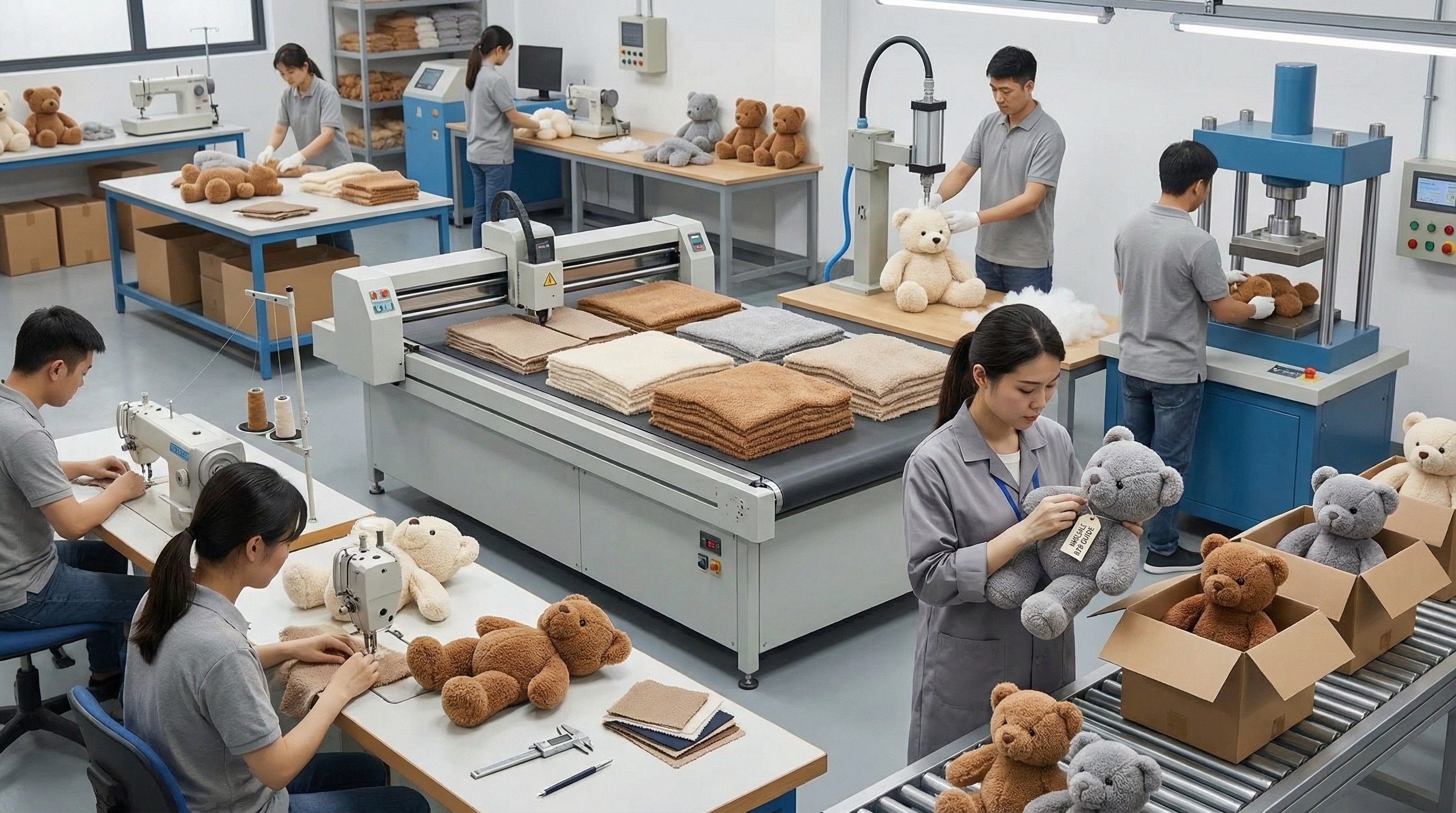
Inside an OEM plush toy production line—cutting, stuffing, stitching, and QC stations operating in sequence.
Common Sourcing Mistakes (and How to Avoid Them)
- Skipping the approved sample step. Without a signed-off reference sample, you have no contractual basis for a quality claim. Always retain one sealed sample.
- Ignoring safety testing costs. Third-party lab testing (SGS, Bureau Veritas, Intertek) for EN 71 or ASTM F963 typically costs $300–$800 per SKU. Budget for it upfront.
- Choosing the lowest bidder without auditing capacity. A factory quoting 20% below market may be subcontracting to an uncertified workshop. Ask for a virtual or on-site factory tour.
- Underestimating supply chain lead times. Holiday-season orders (Q4 retail) should be placed no later than July to account for peak-season factory congestion and shipping delays.
Frequently Asked Questions
What is the typical MOQ for teddy bear plush toy wholesale?
Most factories set MOQs between 500 and 3,000 pieces per design. Catalog (non-custom) styles often have lower minimums; fully custom OEM designs may require 1,000+ units to justify tooling and setup.
How do I verify that a custom teddy bear manufacturer meets safety standards?
Request copies of current EN 71, ASTM F963, or CPSIA test reports issued by an accredited lab. Cross-check the lab's accreditation on the ILAC or CPSC recognized-lab lists. Do not accept self-declared compliance without third-party documentation.
Can I order a mix of sizes and colors in one bulk teddy bear order?
Yes, but each unique SKU (size + color + logo variant) typically needs to meet the per-SKU MOQ. Mixing too many variants in a small total order raises unit costs and complicates QC.
What's the difference between an OEM plush toy supplier and a trading company?
An OEM supplier owns or directly operates the production facility, giving you more control over quality, lead time, and customization. A trading company acts as an intermediary—sometimes useful for smaller orders but adding a margin layer and reducing transparency.
Related Solutions Worth Exploring
If you're building out a broader product catalog or sourcing across categories, these resources may be useful:
- Browse our full product catalog for complementary wholesale items across multiple categories.
- Visit our blog for more illustrated B2B sourcing guides, including our Industrial Corrugated Board Buyer Guide—relevant if you're also sourcing custom packaging for your plush toy line.
Conclusion: Source With Confidence, Not Just Price
Successful teddy bear plush toy wholesale sourcing comes down to three things: choosing a supplier with verified manufacturing capabilities, managing the sample-to-shipment workflow with clear checkpoints, and aligning your product specification to the actual end-use channel. The buyers who get the best results treat their plush toy supplier as a production partner—not just a vendor responding to an RFQ.
Whether you need a standard catalog bear or a fully custom OEM design with branded packaging, the right starting point is a detailed brief and an honest conversation about volume, timeline, and quality expectations.
Ready to start your next bulk teddy bear order? Submit an inquiry here with your target quantity, design concept, and delivery timeline. Our team will return a detailed quotation—including unit pricing, sample timeline, and shipping options—within 3 business days.