Teddy Bear Plush Toy Wholesale: The Complete B2B Sourcing & Procurement Guide
Whether you're a gift retailer stocking seasonal inventory, an amusement park operator sourcing carnival prizes, or a brand manager developing a custom mascot, teddy bear plush toy wholesale sourcing is one of those deceptively complex procurement tasks. The product looks simple—fabric, stuffing, stitching—but the gap between a plush toy that delights customers and one that triggers returns, safety complaints, or margin erosion is enormous.
This guide walks procurement teams and resellers through the practical decisions that determine quality, cost, and delivery reliability when sourcing wholesale teddy bears. We cover supplier evaluation, OEM customization workflows, safety compliance, cost structures, and the specific questions you should be asking before you commit to a purchase order.

Quick Answer: What Does Teddy Bear Plush Toy Wholesale Actually Involve?
At its core, wholesale plush toy sourcing means purchasing stuffed teddy bears in bulk—typically starting at 300–500 units per design—from a manufacturer or trading company, at per-unit prices significantly below retail. Buyers generally fall into three categories:
- Resellers and retailers buying stock designs at the lowest landed cost
- Brand owners and promotional buyers working with a custom teddy bear manufacturer to develop unique designs with branded elements
- OEM/ODM buyers partnering with an OEM plush toy supplier to produce proprietary products under their own label
The sourcing path you choose—stock catalog vs. semi-custom vs. full OEM—determines your minimum order quantities, lead times, unit costs, and the level of quality control you'll need to manage. Let's break each decision down.
Buyer Checklist: 8 Critical Evaluation Points Before You Order
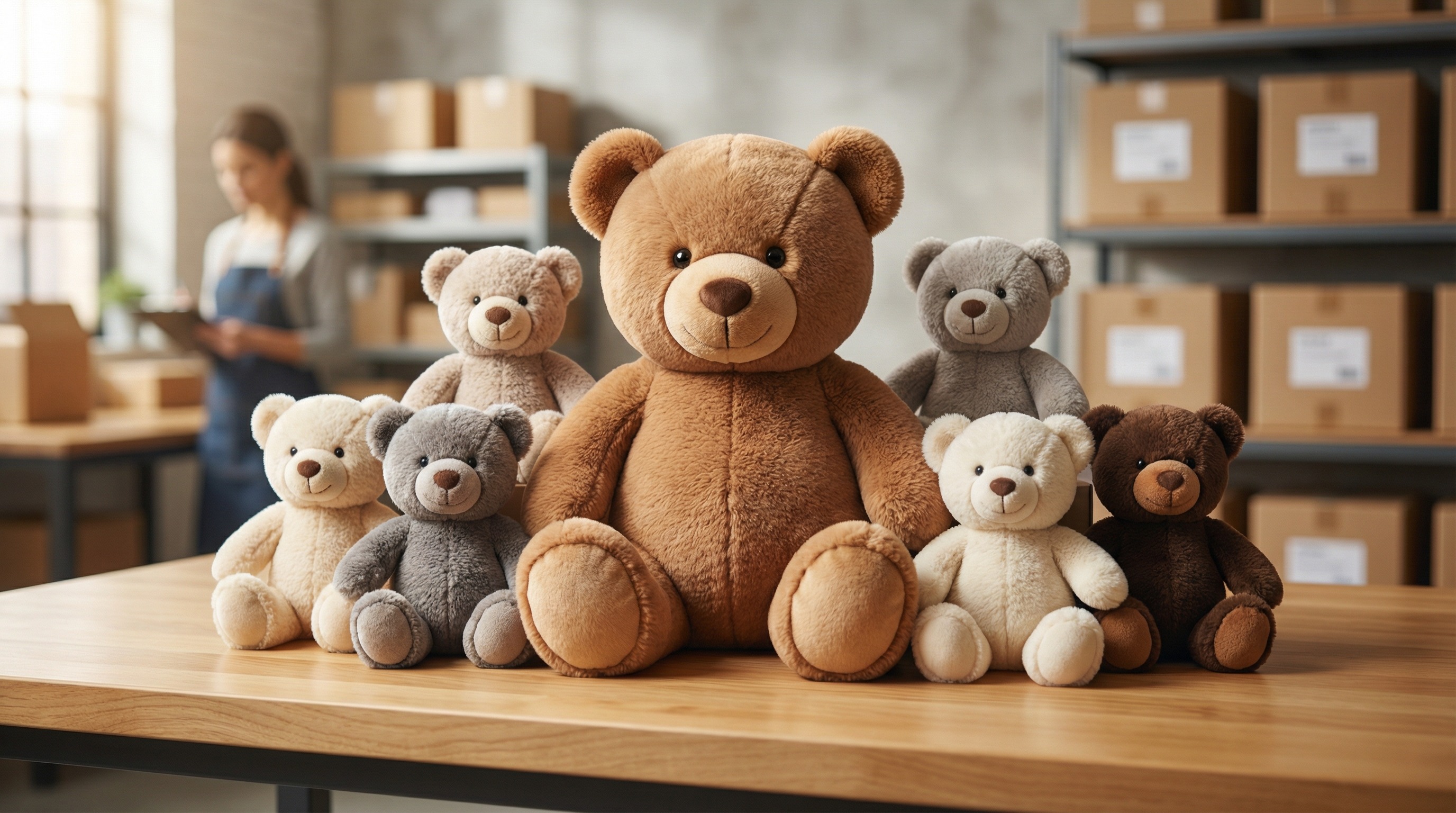
Before requesting quotes from any supplier, align your internal team on these eight factors. They'll save you weeks of back-and-forth and prevent the most common wholesale sourcing mistakes.
- Target market and age group: Children under 3 require EN 71 (EU) or ASTM F963 (US) compliance with no small parts. Adult collectible buyers tolerate finer details.
- Material specification: Short plush, long plush, crystal super-soft, organic cotton—each has a different hand-feel, cost, and durability profile.
- Fill type: PP cotton (standard), PE pellets (weighted feel), or recycled polyester (sustainability claims). Confirm fill meets CPSIA or REACH requirements.
- Size range: 15 cm keychain bears to 120 cm giant display bears. Shipping costs scale dramatically with size—a 60 cm bear can cost more to ship than to manufacture.
- Customization level: Logo embroidery, custom colors, unique patterns, branded hang tags, or fully bespoke sculpted designs.
- MOQ tolerance: Stock designs may start at 100–300 pcs; custom OEM designs typically require 500–3,000 pcs per SKU.
- Compliance documentation: Confirm the supplier can provide test reports from accredited labs (SGS, Bureau Veritas, Intertek) for your target market.
- Packaging requirements: Polybag, individual box, display-ready PDQ, or bulk carton—each affects unit cost and container utilization.
If you're still defining your requirements, our team can help you scope the right approach. Start an inquiry here and we'll walk through specifications together.
Cost Structure: What Drives the Price of Wholesale Plush Teddy Bears?
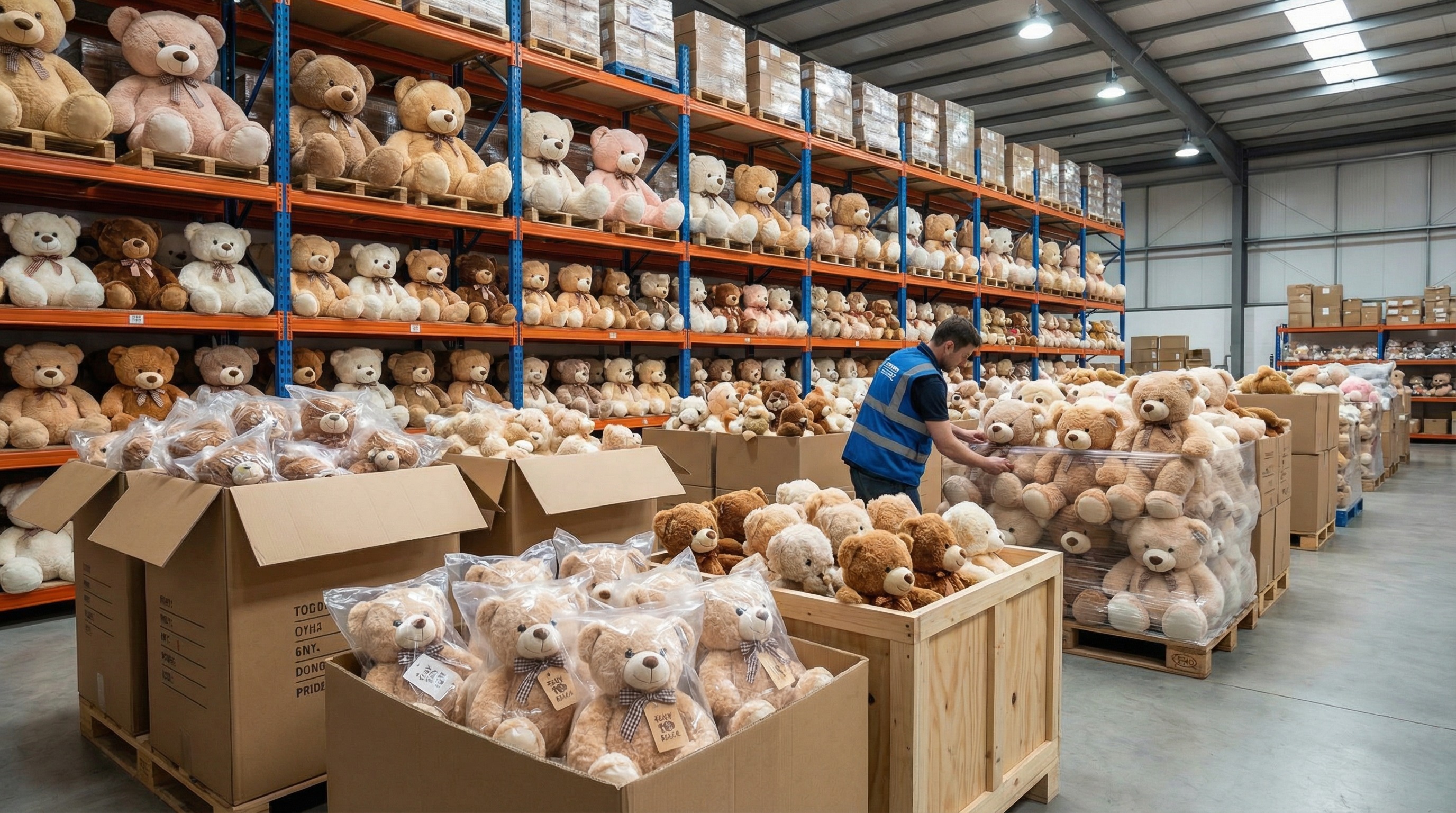
Understanding the cost anatomy helps you negotiate smarter and avoid the trap of choosing the cheapest quote only to pay more in rework, delays, or failed inspections.
| Cost Component | Stock / Catalog Design | Semi-Custom (Logo/Color) | Full OEM / Bespoke Design |
|---|---|---|---|
| Material & fill | 30–40% of unit cost | 30–40% | 25–35% |
| Labor (cutting, sewing, stuffing, finishing) | 25–35% | 25–35% | 30–40% |
| Design / tooling / pattern development | $0 (amortized) | $50–$200 setup | $200–$800+ NRE |
| Compliance testing | Existing reports available | May need re-testing | Full test suite required |
| Typical MOQ | 100–500 pcs | 300–1,000 pcs | 500–3,000 pcs |
| Lead time | 7–15 days | 15–30 days | 30–60 days |
| Unit price range (20–30 cm bear) | $1.50–$4.00 | $2.50–$6.00 | $3.50–$10.00+ |
Key insight: Freight and duties often represent 15–30% of your landed cost, especially for large or lightweight-but-bulky plush items. Always request CBM (cubic meter) data per carton so you can calculate container utilization before committing to order quantities.

Evaluating a Custom Teddy Bear Manufacturer: What Separates Good from Risky
The plush toy supply chain is crowded. Alibaba alone returns thousands of results for "teddy bear factory." Here's how experienced procurement teams filter the noise:
Production Capability Verification
- In-house pattern making and sample room: A credible custom teddy bear manufacturer should produce pre-production samples within 5–10 days, not outsource them.
- Embroidery and printing capacity: Verify whether logo application is done in-house or subcontracted. In-house means better quality control and faster turnaround.
- Annual output: Factories producing 500,000+ units/year typically have more stable quality systems than micro-workshops.
Compliance and Safety Infrastructure
For any product intended for children, safety compliance is non-negotiable. The two primary standards are ASTM F963 (United States, administered by ASTM International, current edition 2023) and EN 71 (European Union). Both cover mechanical/physical properties, flammability, and chemical migration. A reliable OEM plush toy supplier should have current test reports on file and be familiar with the testing process—not scrambling to figure it out after you place an order.
Communication and Project Management
- Does the supplier assign a dedicated project coordinator?
- Can they provide photo updates at cutting, sewing, stuffing, and packing stages?
- Do they accept third-party inspection (e.g., SGS pre-shipment inspection)?
For a deeper dive into sourcing workflows and supplier vetting, see our related guide: Teddy Bear Plush Toy Wholesale: The Complete B2B Sourcing Guide.
OEM Plush Toy Supplier Workflow: From Concept to Container
If you're developing a proprietary design—a brand mascot, a licensed character, or a promotional giveaway bear—here's the typical production workflow when working with an experienced OEM plush toy supplier:
- Design brief submission: Provide sketches, reference photos, Pantone colors, size specs, and any branding assets. The more detail, the fewer revision rounds.
- Pattern development & first sample: Factory creates a 3D pattern and produces a hand-sewn prototype (5–10 days). Expect 1–3 revision rounds.
- Sample approval & compliance testing: Approved sample is sent to an accredited lab. Testing takes 5–10 business days depending on the standard.
- Pre-production sample (PPS): A production-line sample confirms that mass production will match the approved prototype.
- Bulk production: Typical run time is 20–35 days for 1,000–5,000 units, depending on complexity.
- Quality inspection: In-line and final random inspection per AQL 2.5 (standard for consumer goods).
- Packaging & loading: Vacuum-compressed polybags can reduce carton volume by 40–60%, significantly improving container utilization for large bears.
Pro tip: Request that your supplier vacuum-pack samples so you can verify the product recovers its shape after decompression. Cheap fill materials lose loft permanently.

Application Scenarios: Who Buys Teddy Bears in Bulk?
Wholesale plush teddy bears serve a surprisingly wide range of commercial applications:
- Retail & e-commerce: Gift shops, toy stores, Amazon/Shopify sellers building private-label plush lines
- Amusement & entertainment: Carnival prizes, claw machine stock, theme park merchandise
- Corporate & promotional: Branded giveaways, event merchandise, hospital comfort programs
- Hospitality & tourism: Hotel welcome gifts, destination-branded souvenir bears
- Charity & fundraising: Custom bears for nonprofit campaigns, awareness programs
Each application has different priorities. A claw machine operator optimizes for eye-catching colors at the lowest possible unit cost. A children's hospital needs impeccable safety compliance and washability. A luxury hotel brand demands premium materials and elegant packaging. Define your use case clearly before engaging suppliers—it shapes every downstream decision.
Packaging, Loading, and Delivery Readiness
Plush toys are lightweight but bulky. Shipping economics matter as much as unit price. Key considerations:
- Vacuum compression: Reduces volume by up to 60%. Essential for bears over 30 cm. Confirm recovery quality with your supplier.
- Carton specs: Standard export cartons (5-ply corrugated) with clear shipping marks. Request inner polybag + outer carton for moisture protection.
- Container planning: A 40' HQ container holds approximately 65–70 CBM. Get exact carton dimensions and quantity-per-carton data to calculate total container fill before finalizing order volume.
- Delivery terms: Most plush toy factories quote FOB (port). If you need DDP or door-to-door, confirm whether the supplier or a third-party forwarder handles customs clearance.
Frequently Asked Questions
What is the minimum order quantity for custom teddy bears?
Most factories require 500–1,000 pieces per design for fully custom OEM orders. Semi-custom orders (existing design with logo or color changes) may start at 300 pieces. Stock catalog designs can sometimes be ordered in quantities as low as 100 units.
How do I verify that a plush toy supplier meets safety standards?
Request copies of third-party test reports from accredited laboratories (SGS, Intertek, Bureau Veritas, TÜV) covering the specific standards for your market—ASTM F963 for the US, EN 71 for the EU, or GB 6675 for China. Verify the report matches the exact product SKU you're ordering.
How long does it take to develop a custom teddy bear from scratch?
Expect 7–14 days for sampling (including 1–2 revisions), 5–10 days for compliance testing, and 20–35 days for bulk production. Total timeline from design brief to shipment-ready goods is typically 45–60 days.
Can I order mixed sizes or designs in one shipment?
Yes, but each unique design or size typically needs to meet its own MOQ. Discuss assortment packs with your supplier early—some factories offer flexible MOQ splits for repeat buyers.
What's the best way to reduce shipping costs for plush toys?
Vacuum compression is the single most effective strategy. Beyond that, optimize carton dimensions to maximize container fill, consolidate shipments where possible, and consider sea freight over air for non-urgent orders.
Related Resources
Continue building your sourcing knowledge with these related guides and tools:
- Teddy Bear Plush Toy Wholesale: B2B Sourcing Guide — A complementary overview covering supplier landscapes and negotiation strategies.
- Browse Our Full Product Catalog — Explore available wholesale and custom product options.
Conclusion: Source Smarter, Not Just Cheaper
Successful teddy bear plush toy wholesale procurement isn't about finding the lowest quote on a spread