Why Buyers Care About the Part, Not Just the Process
Листовой металл вырезанный лазером is easy to overlook when a machine, trailer, or frame is being specified, but the part often carries more responsibility than it first appears. A bracket, guide, cover, support, or connector section may not be the largest item in the assembly, yet it can decide whether holes line up, whether a cover sits flat, and whether a bolted joint survives vibration instead of loosening after a few months on the road.
That is why engineers and sourcing teams should read laser-cut sheet metal parts as functional components, not just as shaped steel. The cutting method matters because it influences edge quality, repeatability, and how much finishing is needed before the part is ready for assembly. In transport equipment, construction machinery, and industrial frames, those details translate directly into labor time and service life.
The buyer’s real question is usually not whether the part can be cut. It is whether the part can be cut consistently, bent accurately, protected against corrosion, and delivered in a form that reduces rework on the shop floor.
What the Part Itself Suggests
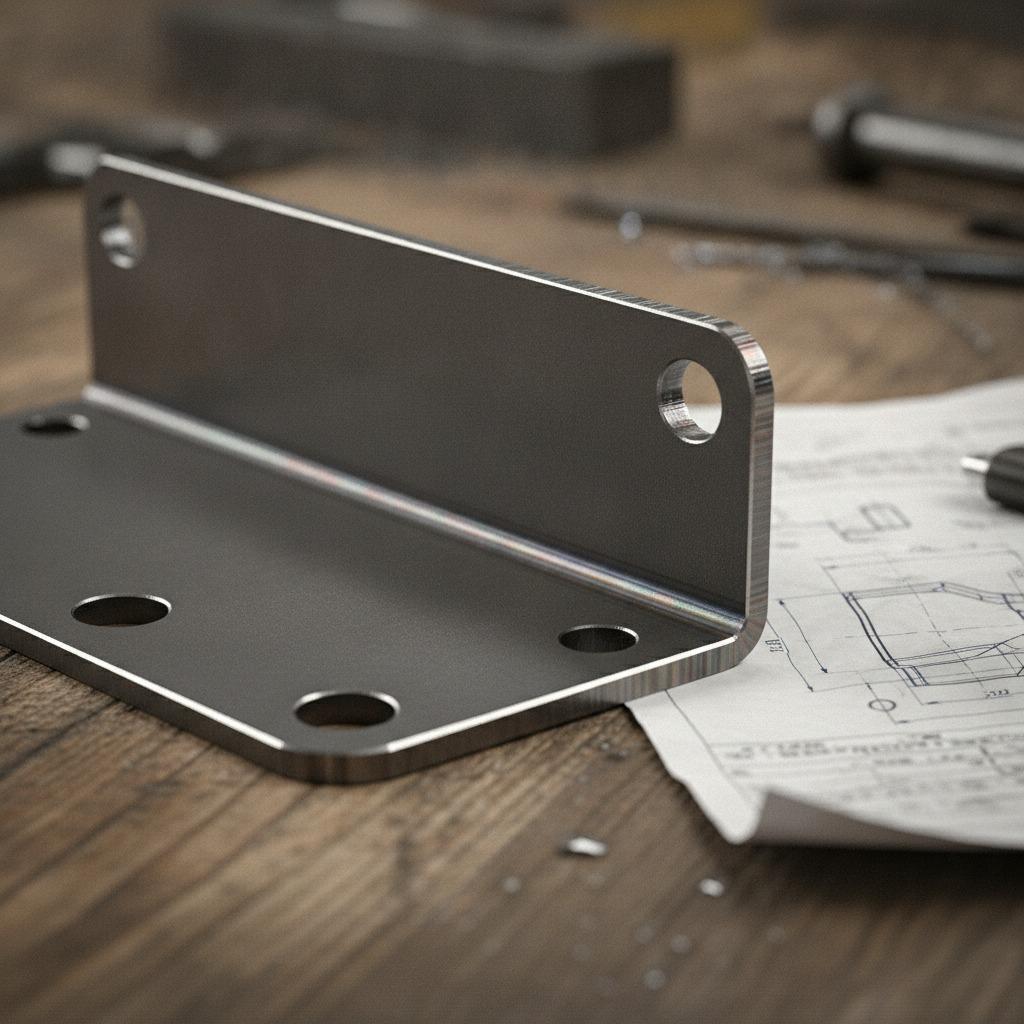
From the visible geometry, the part looks like a serial component made from steel sheet, with a dark matte surface, brighter cut edges, and visible thermal marks around some internal openings. The long open section, straight walls, rounded cutouts, and round mounting holes point to a manufacturing route that likely combines laser cutting with subsequent bending. In some cases, welding may also be involved, especially if the final structure needs extra stiffness or attachment points.
That said, the visual evidence only tells part of the story. You can usually infer that the manufacturer wanted clean contours, repeatable hole locations, and a shape that would be difficult or inefficient to produce with conventional punching alone. You cannot, however, confirm the exact sheet thickness, steel grade, coating system, or whether the part came from a single blank or from multiple joined sections without technical data.
For buyers, that uncertainty is normal. The safe move is to treat the image as a starting point and then ask for the drawing, material specification, and finish requirements before making any pricing or sourcing decision.
Where These Parts Fit in Heavy-Duty Equipment
Parts like this show up everywhere in transport and industrial assemblies. In semi-trailers and truck bodies, they may act as mounts, reinforcement plates, guard sections, guide channels, or support brackets. In flatbeds, low beds, dumps, tankers, and side curtain trailers, similar pieces help form the structure that keeps the larger system aligned and serviceable.
These components also matter because they are often repeated in batches. A single bracket is easy to admire on a bench; fifty identical brackets are what make or break an assembly line. If the hole pattern drifts, the bend angle varies, or the coating interferes with fit-up, the issue becomes expensive very quickly. Workers either spend time forcing the assembly, or they stop and send parts back for correction. Neither outcome is attractive in a production setting.
Why Laser Cutting Is Often Chosen
Clean geometry and repeatability
Laser cutting is favored when the part needs precise outlines, rounded corners, and accurately placed mounting holes. It handles complex internal cutouts well and supports efficient nesting on the sheet, which can improve material utilization. That matters for buyers because the process is not only about appearance; it also affects cost structure and consistency across batches.
A practical path to downstream forming
When a sheet part is meant to be bent afterward, laser cutting can create the flat pattern with the right allowances and hole positions before forming. For long profiles and open sections, that sequence is common: cut first, then bend, then coat or finish. If the supplier understands the order correctly, the result is a part that fits the assembly with fewer surprises.
Where the process has limits
Laser cutting is not magic. Thick material, poor fixture planning, weak nesting strategy, or unclear drawing control can all reduce the value of the method. Heat-affected coloration on the cut edge is normal on many steel parts, but it should not be ignored if the edge will be exposed, welded, painted, or used in a corrosion-sensitive environment. Buyers should ask how edge condition is handled after cutting and whether deburring, cleaning, or surface preparation is included.
Selection Criteria That Matter in Purchasing
When sourcing a laser-cut sheet part, the most useful questions are practical ones. What material is specified? What thickness range is acceptable? Are the mounting holes critical, or do they allow some tolerance for assembly? Will the part be painted, powder coated, galvanized, or left with another protective finish? Will it be bolted, welded, or both?
The answer to each question changes the manufacturing route. A bracket meant for a truck chassis does not need the same finish strategy as a hidden internal support. A visible cover on a trailer body has different requirements from an internal connector that never sees weather. If those distinctions are not made early, the buyer often pays later in extra finishing or field adjustment.
Batch repeatability matters too. For repeated production, suppliers should be able to hold geometry from part to part and from order to order. This is where a manufacturer with disciplined inspection practices has an advantage. SAIL, for example, says its operations are supported by ISO 9001, SGS, and TUV-certified quality systems, along with an annual capacity of over 30,000 units. For buyers, that combination signals a process environment built for volume, consistency, and export-oriented supply rather than one-off fabrication.
Common Mistakes Buyers Still Make
The first mistake is buying on shape alone. A clean outline does not mean the part is ready for assembly. Edge burrs, hole placement, bend recovery, and coating compatibility still need to be checked.
The second mistake is leaving load assumptions vague. If a part is acting as a support or connector in a trailer or equipment frame, the supplier needs enough context to judge whether additional reinforcement is sensible. Without that, the design may look fine on paper but behave poorly in service.
The third mistake is ignoring downstream process fit. If a part will be painted, for example, the design should allow coating thickness without interfering with fastener fit. If it will be welded, the edge quality and surface condition become more important. These are small details until they cause a line stoppage.
What SAIL Adds to the Discussion
SAIL’s main business is heavy-duty transport solutions, including semi-trailers and trucks for logistics companies and construction firms across the Middle East, Africa, and Southeast Asia. That background matters because a supplier serving that market usually understands the demands placed on brackets, mounts, and structural sheet parts: vibration, load cycling, corrosion exposure, and the need for dependable serial production.
The company also supplies auto parts such as axles and filters and offers OEM/ODM capability. In practical terms, that makes it suitable for buyers who need more than a cut part; they need a part that fits into a broader vehicle or trailer program, with predictable supply and the ability to adapt the design when the application changes.
For buyers of transport equipment, that is often the real value. A part may be simple in appearance, but it needs to live inside a system that is not simple at all.
Quick Buyer Questions
Is laser cutting enough on its own? Sometimes yes, but not when the part needs bends, welds, surface protection, or strict edge condition. Most production parts need a full process plan, not just a cut file.
Why do the cut edges look darker or brighter than the surface? That is usually a sign of thermal cutting and subsequent oxidation or material exposure. It is common, but the supplier should explain whether any cleaning or finishing is included.
Should I request drawings or only send a sample photo? Always request drawings if the part affects structure, fit, or safety. A photo helps with identification, but it cannot replace technical requirements.
Next Step for a Proper RFQ
If you are sourcing a similar part, send the drawing, material callout, thickness, finish requirement, quantity, and the way the part will be assembled. If the part belongs in a trailer, truck body, or industrial frame, include the load path and the service environment as well. That saves time on both sides and usually leads to a more realistic quotation.
For buyers evaluating suppliers, the best offer is not always the cheapest cut. It is the one that arrives with the right geometry, the right finish, and fewer surprises when the first batch reaches the floor.